Apply Now

BS in Mechanical Engineering

The mechanical engineering degree builds on concepts studied in physics, math and the sciences. Its aim is to prepare students to be knowledgeable in their fields and effective problem solvers. The first two years of study focus mainly on math and physics with some introductory engineering courses. During the second two years students are introduced to more complex and more specific mechanical engineering concepts through a multitude of courses. The senior capstone project allows students to combine theory and practice in order to solve a specific engineering problem.

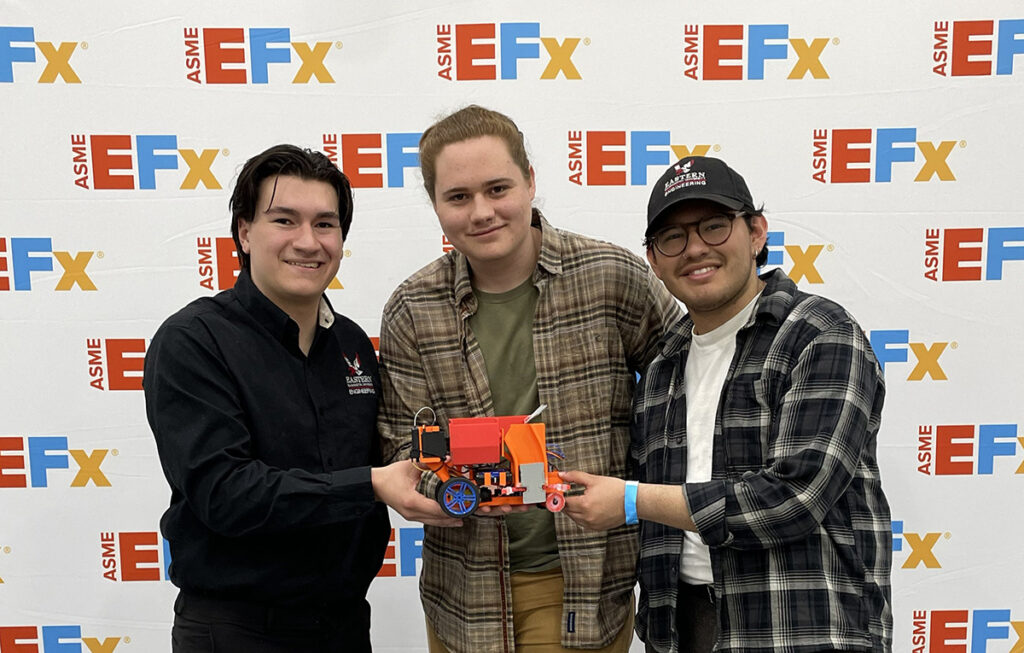
If you have an interest in Mechanical Engineering, check out our Human Powered Paper Vehicles contest!

ME Advising Package for the Cheney Campus

Academic Year 2011-12

What will I study?

Robotics and Automation

In this course, you will learn how to program and develop experiments for Robix Robotic kits, SCARA type industrial Adept Robots, FANUC articulated Robots and PLC program problems using Allen Bradley PLC's and ladder logic programming. This includes the design and manufacturing of any necessary tools or attachments.

Thermodynamics and Heat Transfer

The laws and concepts of thermodynamics are examined. Learn about turbines, internal combustion engines, heat pumps and air conditioners in the classroom as well as the laboratory. Learn the concepts of heat transfer and analyze them first hand in the lab.

Fluids

Learn about the concepts of fluid flow and how they affect the behavior of liquids and gas. Examine and analyze fluid behavior under different conditions in the many laboratories this course offers.

Solid Mechanics and FEA

Solid mechanics is the science of analyzing the behavior of solid materials under loads. Learn how some materials behave under some conditions while using Finite Element Analysis to simulate some of these problems.

Materials

You will achieve a thorough understanding of engineering materials, their properties, responses and applications. The laboratory work includes destructive and non destructive testing and image analysis of microscopic structure of different industrial materials.

Accreditation

Please note that the BSME program at Eastern Washington University is a new program and has not yet been accredited by ABET. As a new program, we cannot apply for accreditation until our first cohort of students receives their degrees. Once the accreditation is formally granted our graduating students will be retroactively included.

Our BSME program has been modeled after other ABET-accredited programs, and Eastern Washington University plans to apply for ABET accreditation as soon as the first cohort of students receives their degrees. However, the program's pre-accreditation status limits the ability of students and graduates interested in obtaining professional engineer licensure in Washington State to use their educational experience to satisfy requirements for taking the fundamentals of engineering examination, registering as an engineer-in-training, and registering as a licensed professional engineer.

Licensure requirements vary by state. For more information about engineering licensure in the state of Washington, please visit http://www.dol.wa.gov/business/engineerslandsurveyors/elreq.html.
For more information about ABET accreditation, please visit http://www.abet.org/.

Emphases / Concentrations:

  • Robotics and Automation
  • Thermodynamics and Heat Transfer
  • Fluids
  • Solid Mechanics and FEA
  • Materials

Interesting courses I might take:

  • ENGR 217 3D Parametric Computer Aided Drafting
  • ENGR 385 Robotics and Automation
  • ENGR 405 Design of Machine Elements
  • ENGR 456 Engineering Ethics, Contracts and Patents
  • TECH 301 Metallic Processes
  • TECH 393 Technology in World Civilization
  • TECH 403 Computer-Aided Design and Project Management

What could I do with my degree?

  • Mechanical engineering is one of the broadest disciplines in engineering. A graduate with a BSME can expect a wide range of options. Mechanical engineers are in high demand in the bio-mechanical field, aeronautics, structural applications, energy transfer, to name only a few. Many of our graduates have started their careers with some of the major companies around the Northwest, such as Boeing and Microsoft.
© 2012 Eastern Washington University