EWU Digital Badging

Verifiable, Interoperable, Skills-based, Secure

As a regional polytechnic university, EWU is actively working to advance innovation in Learning and Employment Records (LER) and digital credentials across our region. Through grant-supported collaborations and a strong emphasis on experiential learning, EWU is building pathways for students to access secure, verifiable, and portable credentials that reflect both academic achievement and hands-on experience. Our goal is to create trusted, future-ready options for learners to showcase their competencies and share them with employers, professional networks, and beyond.

Explore this page to learn more about how EWU is shaping the future of credentialing and discover opportunities to get involved.

Welcome to EWU Digital Badging

Eastern Washington University is committed to creating flexible pathways for diverse learners by embracing credit mobility. Through the efforts of the EWU Credentialing Committee and cross-campus partners, EWU is supporting learners access to certificates, microcredentials, and digital badges that are secure, verifiable, and interoperable, making it easy to share achievements with employers and across platforms.

These credentials are designed to work seamlessly within Learning and Employment Records (LERs), giving students a portable, lifelong record of their skills and accomplishments.


Glossary of Terms

Digital Badge

“A digital badge (aka e-badge) is a digital representation of individuals’ achievements, consisting of an image and metadata uniquely linked to the individual’s skills. Digital badges have an issuer (institution that testifies), an earner (learner), and a displayer (site that houses the badge). Badges can be displayed, accessed, and verified online.”

Learn & Work Ecosystem Library glossary. Learn & Work Ecosystem Library. (n.d.) Digital badge | Learn & Work Ecosystem Library

Microcredential

“Microcredentials (micro-credentials) are a record of focused learning achievement verifying what the learner knows, understands, or can do. They include an assessment based on clearly defined standards and are awarded by a trusted provider. They have stand-alone value and may also contribute to or complement other micro-credentials or macro-credentials, including through recognition of prior learning. They meet the standards required by relevant quality assurance.”

Learn & Work Ecosystem Library glossary. Learn & Work Ecosystem Library. (n.d.) Microcredentials (Micro-Credentials) | Learn & Work Ecosystem Library

Stackable Credential

“Stacking credentials is part of a sequence of credentials that can be accumulated over time to build up an individual’s qualifications and help them to move along a career pathway or up a career ladder to different and potentially higher-paying jobs. Stackable credentials can be viewed as building blocks where each short-term credential that a person earns builds into a higher-level credential.”

Learn & Work Ecosystem Library glossary. Learn & Work Ecosystem Library. (n.d.) Stackable Credentials | Learn & Work Ecosystem Library

Industry Certification/Professional Certification

“Credentials that are awarded by certification bodies—typically nonprofit organizations, professional associations, industry and trade organizations, or businesses. Certifications are based on individuals demonstrating through an examination process that they have acquired the knowledge, skills, and abilities required to perform a specific occupation or job. Depending on the certification body, the credential may be called an industry or a professional certification. Although training may be provided, certifications are not tied to completion of a program of study as are certificates. Certifications are time limited and may be renewed through a re-certification process.”

Learn & Work Ecosystem Library glossary. Learn & Work Ecosystem Library. (n.d.) Industry Certification / Professional Certification | Learn & Work Ecosystem Library

Academic Certificate

“Type of award conferred by a college, university, or other postsecondary education institution indicating the satisfactory completion of a non-degree program of study. Typically, the course requirements for earning a certificate are less than those for earning a degree. Most certificates require no more than one year of full-time academic effort. A certificate may be for-credit (academic certificate) or non-credit (continuing education certificate). They are not time limited and do not need to be renewed.”

Learn & Work Ecosystem Library glossary. Learn & Work Ecosystem Library. (n.d.) Certificate | Learn & Work Ecosystem Library

Stackable Credential Pathway Model

Microcredential Model

Microcredentials are small, verified learning achievements that show what the learner knows or can do. They’re assessed against clear standards, issued by trusted providers such as EWU, and can stand alone or stack toward larger credentials.

Example of an EWU Microcredential: 

Microcredential Title: Key Principles for Teaching English as a Foreign Language

Microcredential Coursework:

Interaction, Fluency and Accuracy, Scaffolding, Resources, Negotiation of meaning, Clear objectives, Authentic tasks, Communicative language teaching, Teaching with the sound turned off, Comprehensible input

Stackable Credential:

Results in an EWU Stackable Microcredential. When combined with the other microcredentials in this pathway, learners can earn a Teaching English as a Foreign Language (TEFL) Certificate.

Other Microcredentials in this Pathway:

  • Principles for Developing Reading Skills
  • Principles for Developing Writing Skills
  • Principles for Developing Listening Skills
  • Principles for Developing Speaking Skills
  • Skillful Assessment
  • Navigating Culture in English as a Foreign Language
  • Success in the Field
  • Job Seeking in English as a Foreign Language

Stackable Credential Model

EWU Stackable Credentials provide a flexible, modular learning approach, enabling learners to acquire targeted skills while progressing toward broader qualifications.

Example of an EWU Stackable Microcredential Pathway:

Teaching English as a Foreign Language (TEFL) Certificate:

The TEFL Certificate Stackable Credential integrates nine distinct microcredentials, delivering essential workforce-aligned competencies and creating a non-traditional, adaptable pathway to career readiness.

9 Microcredentials stacked together result in = TEFL Certificate

Mapping Breakdown: Microcredentials in Certificate

  • Key Principles for Teaching English as a Foreign Language
  • Principles for Developing Reading Skills
  • Principles for Developing Writing Skills
  • Principles for Developing Listening Skills
  • Principles for Developing Speaking Skills
  • Skillful Assessment
  • Navigating Culture in English as a Foreign Language
  • Success in the Field
  • Job Seeking in English as a Foreign Language

Program Information Here

Planning Ahead to EWU

These EWU Stackable Credentials offer learners a flexible way to acquire targeted in-demand skills and create a pathway to a successful future at Eastern Washington University.

Imagine learners building their degree incrementally, leveraging their existing skills for a smooth entry into the full bachelor’s program.

This innovative approach empowers learners to advance their goals through diverse pathways, building a strong professional foundation while connecting to continued learning opportunities within EWU’s degree programs

Complete your Degree with EWU!

Contact the EWU Admissions/Credit for Prior Learning (CPL) team to plan your pathway to degree with an educated Eagle Team Member today!

Credit Mobility Grants

This grant is informed, in part, from the collective grant work related to credit mobility led at Eastern Washington University mentioned on this page.

February 2025 – August 2026 | Led by ITHAKA S+R and Complete College America

  • 11 grantees – streamlining credit mobility infrastructure and internal processes.
  • Expanding and aligning articulation agreements and workforce partnerships.
  • Engaging faculty and staff across departments in credit recognition and application toward degrees.
  • Awarding credit for prior learning from many valid sources and through many pathways.
  • Integrating technology to improve transparency, usability, and tracking.
  • More details on this and supporting Grants found here.

EWU Strategic Plan Alignment
Goal: Regional Anchor / Regional Impact
• Outcome: By 2025-2026, EWU will complete a comprehensive regional economic profile using data-driven analytics and use that profile to promote academic offerings that benefit our region in preparation for the development of an academic master plan.
• Outcome: By 2026-2027, 75% of programs will have assessed alignment between program content, student learning outcomes, and regional skills needs; by 2029, 90% of programs will have completed such an assessment.
Goal: Student Success and Experience
• Outcome: Annually increase first to second year retention rate by 1% point, closing structural equity gaps for targeted student populations 1.5-3.0% points, while growing new student enrollment by 0.5 % and targeted student populations 1%.
• Outcome: Annually, increase overall graduation rate by 0.5% points while closing structural equity gaps for targeted populations 1% point.

This work supports and informs the work EWU is doing as part of the Holistic Credit Mobility (HCM) Cohort.

The EdValue Collaborative – Education Strategy Group | Education Strategy Group

  • Deepen understanding of current strategies for advancing credentials of value and ROI.
  • Identify new and innovative actions as a state.
  • Part of a 5-State collaborative (IowaMarylandNew YorkVirginia and Washington)
  • Craft a coordinated plan of action.

EWU Strategic Plan Alignment
Goal: Regional Anchor / Regional Impact
• Outcome: By 2025-2026, EWU will complete a comprehensive regional economic profile using data-driven analytics and use that profile to promote academic offerings that benefit our region in preparation for the development of an academic master plan.
• Outcome: By 2026-2027, 75% of programs will have assessed alignment between program content, student learning outcomes, and regional skills needs; by 2029, 90% of programs will have completed such an assessment.
Goal: Student Success and Experience
• Outcome: Annually increase first to second year retention rate by 1% point, closing structural equity gaps for targeted student populations 1.5-3.0% points, while growing new student enrollment by 0.5 % and targeted student populations 1%.
• Outcome: Annually, increase overall graduation rate by 0.5% points while closing structural equity gaps for targeted populations 1% point.
This work supports and informs the work EWU is doing as part of the Holistic Credit Mobility (HCM) Cohort.

Deliverables by June 2025

• Up to 45 lower-division credits awarded for apprenticeships in Behavioral Health, Peer Counseling, and Substance Use Disorder.
• Direct graduate pathways for SEIU-funded bachelor’s
students into EWU’s MBA Healthcare Administration, Master of Social Work and other concentrations.
• Implementing Credit Predictor Pro to improve transparency in transfer credit evaluations.
• Feasibility study on expanding apprenticeship articulation to EWU’s Psychology degree programs.

EWU Strategic Plan Alignment
Goal: Regional Anchor / Regional Impact
• Outcome: By 2025-2026, EWU will complete a comprehensive regional economic profile using data-driven analytics and use that profile to promote academic offerings that benefit our region in preparation for the development of an academic master plan.
• Outcome: By 2026-2027, 75% of programs will have assessed alignment between program content, student learning outcomes, and regional skills needs; by 2029, 90% of programs will have completed such an assessment.
Goal: Student Success and Experience
• Outcome: Annually increase first to second year retention rate by 1% point, closing structural equity gaps for targeted student populations 1.5-3.0% points, while growing new student enrollment by 0.5 % and targeted student populations 1%.
• Outcome: Annually, increase overall graduation rate by 0.5% points while closing structural equity gaps for targeted populations 1% point.
This work supports and informs the work EWU is doing as part of the Holistic Credit Mobility (HCM) Cohort.

  • Summer Bridge students in 2023 with Merit
  • Project Overview in partnership with the National Governors Association, Merit and Greater Spokane Inc.

EWU Strategic Plan Alignment
Goal: Regional Anchor / Regional Impact
• Outcome: By 2025-2026, EWU will complete a comprehensive regional economic profile using data-driven analytics and use that profile to promote academic offerings that benefit our region in preparation for the development of an academic master plan.
• Outcome: By 2026-2027, 75% of programs will have assessed alignment between program content, student learning outcomes, and regional skills needs; by 2029, 90% of programs will have completed such an assessment.
Goal: Student Success and Experience
• Outcome: Annually increase first to second year retention rate by 1% point, closing structural equity gaps for targeted student populations 1.5-3.0% points, while growing new student enrollment by 0.5 % and targeted student populations 1%.
• Outcome: Annually, increase overall graduation rate by 0.5% points while closing structural equity gaps for targeted populations 1% point.
This work supports and informs the work EWU is doing as part of the Holistic Credit Mobility (HCM) Cohort.

  • Service2Cyber (Military, Spouse/Family, National Guard, JROTC) in 2024-2025 with iQ4 Corportation and their Digital Achievement Wallet.

EWU Strategic Plan Alignment
Goal: Regional Anchor / Regional Impact
• Outcome: By 2025-2026, EWU will complete a comprehensive regional economic profile using data-driven analytics and use that profile to promote academic offerings that benefit our region in preparation for the development of an academic master plan.
• Outcome: By 2026-2027, 75% of programs will have assessed alignment between program content, student learning outcomes, and regional skills needs; by 2029, 90% of programs will have completed such an assessment.
Goal: Student Success and Experience
• Outcome: Annually increase first to second year retention rate by 1% point, closing structural equity gaps for targeted student populations 1.5-3.0% points, while growing new student enrollment by 0.5 % and targeted student populations 1%.
• Outcome: Annually, increase overall graduation rate by 0.5% points while closing structural equity gaps for targeted populations 1% point.
This work supports and informs the work EWU is doing as part of the Holistic Credit Mobility (HCM) Cohort.

  • Therapeutic Recreation Professional and Continuing Education students in 2024-2025 with iQ4 Corportation and their Digital Achievement Wallet.

EWU Strategic Plan Alignment
Goal: Regional Anchor / Regional Impact
• Outcome: By 2025-2026, EWU will complete a comprehensive regional economic profile using data-driven analytics and use that profile to promote academic offerings that benefit our region in preparation for the development of an academic master plan.
• Outcome: By 2026-2027, 75% of programs will have assessed alignment between program content, student learning outcomes, and regional skills needs; by 2029, 90% of programs will have completed such an assessment.
Goal: Student Success and Experience
• Outcome: Annually increase first to second year retention rate by 1% point, closing structural equity gaps for targeted student populations 1.5-3.0% points, while growing new student enrollment by 0.5 % and targeted student populations 1%.
• Outcome: Annually, increase overall graduation rate by 0.5% points while closing structural equity gaps for targeted populations 1% point.

This work supports and informs the work EWU is doing as part of the Holistic Credit Mobility (HCM) Cohort.

May 2025 – April 2026

• 25 universities planning & developing learning & employment records.
• Learner-centered credential innovation
• Systems alignment and governance
• Credit/non-credit integration
• Skills-based curriculum processes
• Vendor collaboration

Details Found: EWU_LER_Accelerator_cohort-rfp_3_3_25.pdf – Google Drive

EWU Strategic Plan Alignment
Goal: Regional Anchor / Regional Impact
• Outcome: By 2025-2026, EWU will complete a comprehensive regional economic profile using data-driven analytics and use that profile to promote academic offerings that benefit our region in preparation for the development of an academic master plan.
• Outcome: By 2026-2027, 75% of programs will have assessed alignment between program content, student learning outcomes, and regional skills needs; by 2029, 90% of programs will have completed such an assessment.
Goal: Student Success and Experience
• Outcome: Annually increase first to second year retention rate by 1% point, closing structural equity gaps for targeted student populations 1.5-3.0% points, while growing new student enrollment by 0.5 % and targeted student populations 1%.
• Outcome: Annually, increase overall graduation rate by 0.5% points while closing structural equity gaps for targeted populations 1% point.

This work supports and informs the work EWU is doing as part of the Holistic Credit Mobility (HCM) Cohort.

April 2025 – October 2026

A Capacity-Building Approach to Institutional Change led by the State Higher Education Executive Officers Association (SHEEO) and Student-Ready Strategies (SRS)

• Improve student success through structural change on college campuses.
• State higher education agencies from Nevada and Washington (led by WSAC) will participate.
• Technical support through in-person workshops, quarterly expert coaching, and asynchronous support.

Details Found: Constellation of Support: A Capacity-Building Approach to Institutional Change – SHEEO

EWU Strategic Plan Alignment
Goal: Regional Anchor / Regional Impact
• Outcome: By 2025-2026, EWU will complete a comprehensive regional economic profile using data-driven analytics and use that profile to promote academic offerings that benefit our region in preparation for the development of an academic master plan.
• Outcome: By 2026-2027, 75% of programs will have assessed alignment between program content, student learning outcomes, and regional skills needs; by 2029, 90% of programs will have completed such an assessment.
Goal: Student Success and Experience
• Outcome: Annually increase first to second year retention rate by 1% point, closing structural equity gaps for targeted student populations 1.5-3.0% points, while growing new student enrollment by 0.5 % and targeted student populations 1%.
• Outcome: Annually, increase overall graduation rate by 0.5% points while closing structural equity gaps for targeted populations 1% point.

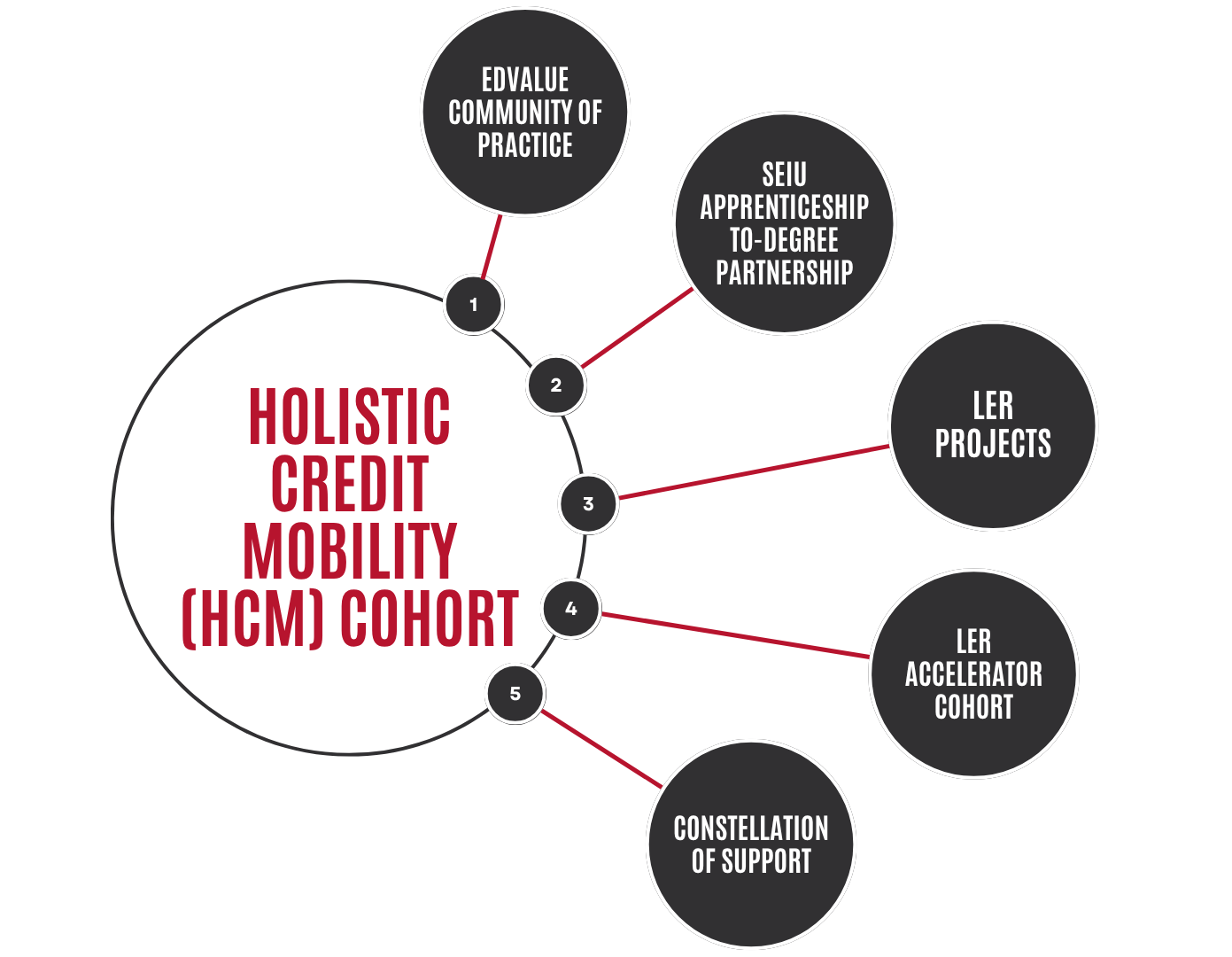
Circle Graph with main circle words "holistic credit mobility cohort" and connecting words, "SEIU Apprenticeship to degree partnership", "LER Projects", "LER Accelerator Cohort, "Constellation of Support".

EWU Credentialing Committee

The EWU Credentialing Committee is a cross-campus group dedicated to shaping how Eastern Washington University recognizes learning beyond traditional transcripts aligned with EWU’s credit mobility efforts. The committee’s work is to inform clear, consistent policies for digital certificates, digital badges, and microcredentials that help students showcase and articulate their skills to potential employers through a secure, verifiable, and interoperable format.

By aligning credentialing with EWU’s credit mobility efforts, the committee helps guide conversations and explore possibilities for flexible, trusted ways for learners to demonstrate achievement, whether through academic programs, professional development, or applied learning experiences.

EWU Credentialing Committee Representatives:

  • Dr. Christi Harter (Lead), Assistant Vice President – Professional & Continuing Education 
  • Dr. Jackie Coomes, Vice Provost – Academic Affairs
  • Dr. Sue Magyar, Director – Interdisciplinary Studies
  • Ashley Stettler, Business Manager – Professional & Continuing Education
  • Mikyla Sears, Program Coordinator – Professional & Continuing Studie
  • Julie Fournier, Program Manager – Records & Registration
  • Ryan Weldon, Assistant Director – Career Development
  • Aimee Pope, Registrar – Records & Registration
  • Dr. Heather Veeder, Associate Vice President – Student Success, Policy & Planning
  • Dr. Gina Mikel Petrie, Executive Director – Global Studies
  • Dr. Luis Matos, Associate Professor – Biology
  • Kandi Teeters, Director – Financial Aid & Scholarships
  • Mark Ward, Management Analyst & Academic Planning – Records & Registration
  • Jens Larson, Associate Vice President – Enrollment Services
  • Michelle Mowrey, Director – Student Engagement and PUB

Cross Campus Departments

Records and Registration, Financial Aid, Enrollment Services, Provost Office, Professional & Continuing Education, Faculty Representatives (multi-college), Career Services, Student Success