Perspective
Volume 12, Number 4, Fall 2001
online
An Online Magazine for Alumni and Friends of Eastern Washington University
   Home
   Top Story >
   Funds   
   Academics  
The First Four Decades
A New Era

The 30's and 40's
The 50's
The 60's
The 70's
The 80's
The 90's
The Future

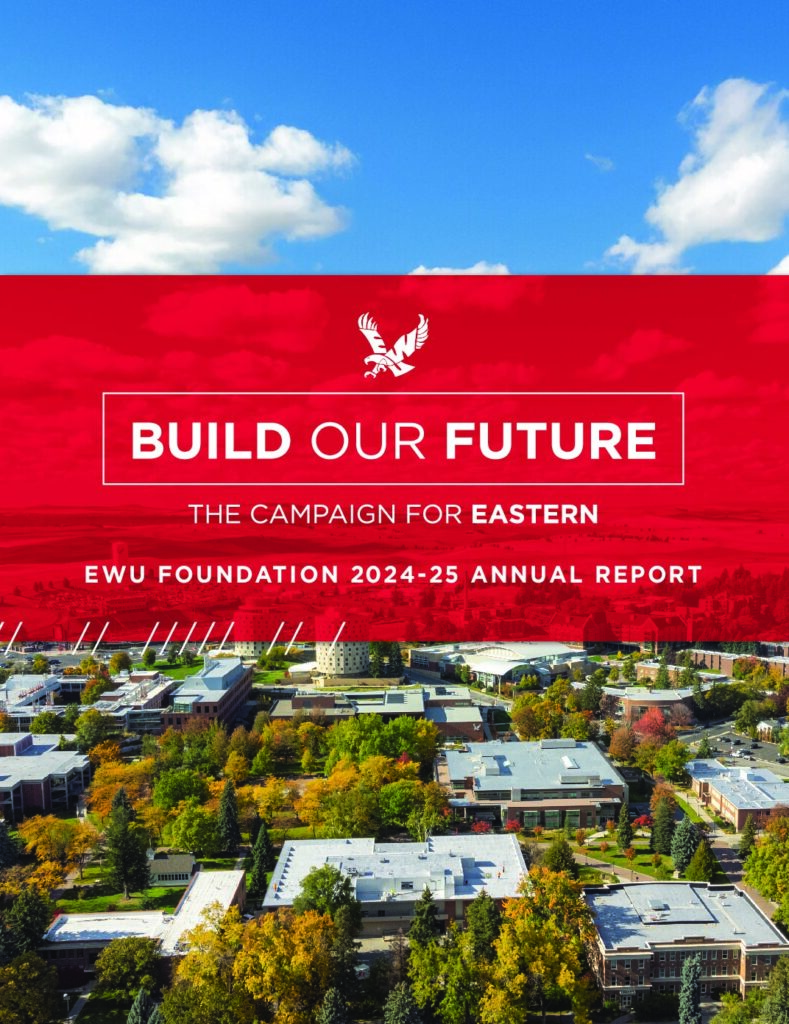
The Changing Campus at Eastern It's a beautiful summer day on the EWU campus.

You're strolling down tree-shaded pathways across the green and newly-mowed lawns, beckoning you toward the decorative brick pavers of Eastern's central mall. Near the center, with a light breeze blowing and the trickle of running water in the background, you pause a moment to glance around and assess the current state of your old alma mater.

There's no denying it - Eastern's campus is strikingly beautiful. And no matter how long it's been since you last set foot on campus, it's easy to see the phenomenal changes that time, commitment and pride have produced at your university.

It all started with a $10,000 gift from railroad mogul Benjamin P. Cheney to establish a school near the railroad line in Cheney. The rest is history...


The First Four Decades

The earliest years were a period of joy and sorrow. Faculty, students and proud members of the Cheney community saw the Benjamin P. Cheney Academy building occupied in 1882, only to be destroyed by fire nine years later.

By 1895, construction of a new building began, but was hampered by financial problems. The building was at last finished in 1896, amidst discord between the school and the town of Cheney over unpaid wages. Even worse, the school's appropriation was vetoed by the Legislature in 1897, forcing it to close for a year. Finally, after a dozen years of growth and optimism, during which the Academy became a Normal School (a state school for the education of teachers), the administration building was again destroyed by fire in the early hours of April 24, 1912.

A replacement building was approved by the 1913 Legislature and the cornerstone of a new administration building was laid. By 1915, the administration building opened to students. (It would later be named Showalter Hall in honor of the school's president Noah Showalter, 1911-26.)

up


A New Era

As if symbolic of the Herculean efforts to keep the institution open, the Pillars of Hercules were built in 1915, just down the pathway (or "Hello Walk") from Showalter Hall. A memorial to the destroyed administration building, the stone pillars were financed by the Alumni Association.

Also in 1915, a Manual Arts Building was built. Courses taught there included woodworking, basketry and mechanical drawing. The next year saw Monroe Hall completed as a women's dorm, and named after Mary Monroe, first woman to serve on the Board of Trustees. The hall would alternately serve as both a men's and women's dorm from 1916 to 1968.

In 1916, a classical statue of native American heroine Sacajawea was dedicated and placed in Showalter Hall. A gift from the class of 1916, it symbolized class unity and loyalty - as the famous Indian maiden had to explorers Lewis and Clark. Damaged several years ago, Sacajawea has recently been restored and once again graces the Showalter Hall first floor lobby area.

As student population increased, it was clear that more residence halls were needed. Senior Hall was completed in 1920 and work commenced on Sutton Hall in 1922, which was named after Senator W. J. Sutton, a longtime friend of the Normal School.

In 1929, the President's Mansion was completed and occupied by President Hargreaves and family. It served as home for all EWU presidents until 1987, then resumed its use with the naming of Stephen Jordan as president in 1998.

up


The '30s and '40s

In this period of depression, international tensions and war, the institution experienced declining numbers, followed by an explosion of new students following WWII. Major campus construction included the new training school building, opened in 1937 and named for Clarence D. Martin, Eastern graduate and then governor of Washington state. This was followed by a separate library building (the library at this time was on the third floor of the administration building).

When the new library was completed in 1940, it was named for the recently deceased president of the Normal School, Richard Hargreaves. Hargreaves Hall is now the home to University Honors, the EWU Alumni Association and the EWU Foundation, so stop by for a visit!

In 1945, servicemen and women returning from World War II caused the student body to swell. Several temporary structures were moved to campus near Showalter Hall for classrooms. The community of "Trailerville" was created near Monroe Hall by hauling 15 trailers from Pasco and setting them up for ex-servicemen students and families.

Also in the 1940s, a student union building (Ratcliffe Hall) was made from a private residence and opened to students. In 1948, construction began on Rowles Hall, to be the school's first fine arts building. Also that year, a fieldhouse with pool and basketball court was opened to students.

up


The 1950s

Campus construction continued in the 1950s, including a women's dorm that later would be named after the head of the Domestic Science Department at Eastern, Louise Anderson. Monroe Hall was renovated and reopened as a men's dorm and a student union building was completed and named after former college president, Walter Isle.

In 1956, Cadet Hall was constructed with funds provided by the United States Army. Over the next 40-plus years, more than 1,000 Eastern cadets would earn their commission as officers in the United States Army. In 1959, a new campus training school (now Reid Elementary) was built and featured a then state-of-the-art student observation area overlooking a classroom.

up


The 1960s

The early '60s saw a Hall of Sciences built after years of planning. Tawanka Dining Hall was completed in 1964 and named in honor of the Tawanka Women's organization, an integral part of Eastern from 1926 until 1960. Also in 1964, Pearce Hall was built as a men's dormitory. Its distinctive circular shape was designed to make maximum use of space for dorm rooms. It was named after George W. Pearce, chief custodian, friend to all students and affectionately called Doc - for Doctor of Fussology.

In 1966, Cheney Hall, built to replace the Manual Arts Building, was opened, along with two more residence halls „ Dressler (named for Graham M. Dressler, who taught at Eastern from 1940 until 1958) and Dryden (named for Cecil Pearl Dryden, who came to Eastern in 1923 and retired in 1957).

In 1967, JFK Library was completed and dedicated, replacing the Hargreaves library, which was remodeled for use by the Home Economics Department. The following year, Streeter Residence Hall was completed and named for Ruth Cheney Streeter, granddaughter of Benjamin P. Cheney, the school's founder. In 1969, Patterson Hall –home to most undergraduate liberal arts courses – was built and named after Don Patterson, EWU president from 1954 -1967.

up


The 1970s

Many ambitious projects were completed during the '70s. The Pence Union Building replaced Isle Hall as the student union building, and was named for Omer O. Pence, an EWU grad and faculty member. Morrison Hall, another residence hall, was completed and named after Zelma Reeves Morrison, director of public relations from 1946 until 1951.

In 1972, the Fine Arts Complex was completed, housing theatre, music and the visual arts. Kingston Hall, home to the college of business administration, also was completed and named for Dr. Ceylon S. Kingston, who taught at Eastern from 1901-1940.

From 1971 to 1981, Eastern's Athletic Complex was built, including a pavilion, indoor track and field building, football stadium, classrooms, activity courts and weight rooms, and an aquatic center.

In 1974, the American Indian Education Center was created by remodeling an existing church on the edge of campus. And Williamson Hall, named after Dr. Obed Williamson, head of the Department of Education in the 1930s, was built in 1977 to connect with Martin Hall.

up


The 1980s

In May 1980, Mt. St. Helens erupted, closing the campus for a week as more than a half inch of volcanic dust fell. It was also a year of eruptions in student/administrative relations. A student proposal to build a $2 million addition to the Pence Union Building was rejected by the Board of Trustees and caused student frustration and anger. When plans were made to take Louise Anderson Hall out of the residence hall system and use it for a regional conference center, student protests resulted in half the building being retained for housing and half for conferences.

In 1982, the former Farm Credit Building was purchased in downtown Spokane to house various programs for the convenience of working students. In 1983, the EWU Spokane Center opened with 33 classrooms and space for 800 students. That same year, the Manual Arts building was remodeled and converted into the university's Computer Science Building.

The following year, construction began on a new computer center between Tawanka Commons and Martin Hall.

In 1988, the Legislature approved development of a joint educational facility called the Spokane Intercollegiate Research and Technology Institute (SIRTI). Designed as a center for applied research and development of marketable scientific products and processes, the facility would be built in Spokane and shared by EWU, Washington State University, Gonzaga University and the Community Colleges of Spokane.

Beginning in 1988, the Science Building was extensively remodeled, adding thousands of square feet of classrooms and laboratory space to the existing building. The new facility was unveiled in 1994.

In 1989, the former President's House was renamed Alumni House and turned into offices and meeting rooms.

up


The 1990s

The decade of the '90s began with a proposal for a $31 million addition to the JFK Library. Increasing student population and inadequate facilities called for a major project of modernization and expansion.

But the library addition was just one of many dramatic projects begun and completed. In 1993, construction of a 75-unit Student Family Housing project began near the Red Barn, designed to accommodate a growing number of students with children.

In 1995, Patterson Hall's auditorium was remodeled and the Pence Union Building's major addition was finally completed, bringing the facility to 112,000 square feet of meeting, dining and office spaces.

Work began on Sutton Hall, turning the long unused dormitory into new headquarters for Registrar, Admissions and Financial Aid offices. The newly remodeled building reopened in 1996 with vastly enhanced facilities and improved service to students because critical student services were now all offered under one roof. The "Showalter Shuffle," as many students called the process of registering in Showalter Hall, at last came to an end.

In 1998, the library project was completed, adding more than 70,000 square feet of new space, improved computer access and space for the nearly 8,000 students now attending Eastern. Simultaneously, the central mall itself– with broken brick pavers and sprouting weeds– was taken back to raw ground, then reconstructed with new brick, lighting, a flowing creek and performance area.

Showalter Hall's auditorium was being remodeled and restored to its original glory, but with a state-of-the-art sound system. The classic hall is now the scene of symphony performances, lectures and other cultural events.

Eastern's new children's center opened in November 1999, and the phase two remodel will be completed this year, allowing for the care of 200 children.

Louise Anderson Hall also reopened in 1999 after remodeling which allowed the facility to house an additional 150 residence hall students. By the following year, another 100 student housing beds were added.

Then came the long-awaited renovation of Monroe Hall, one of the oldest structures on campus. Completed early in 2001, its dramatic new fa­ade welcomes students and alumni to visit the offices of Women's Studies, Chicano Education, African American Education and other programs at Eastern.

Not long after Monroe reopened its doors, there was a brand new (old) face on campus as the Cheney Normal School Heritage Center appeared between Martin Hall and the Computer Science Center. Through the generous contributions of Eastern alumni and friends, The Heritage Center, an actual one-room schoolhouse, moved to campus from the woods outside Newport, Wash. It will open next spring as a museum offering educational tours, seminars and historic presentations, receptions and a display of historical one-room schoolhouse artifacts.

up


The Future

More exciting projects are planned for the coming years on and around the Eastern campus. Among the more ambitious is the rebirth of Cheney Hall as home to the new School of Computing and Engineering Science. This project is about more than just a building. Read more about this project in the section on Changing Academics at Eastern on page 12.

Beginning in 2002, Senior Hall contractors will embark on a major restoration to improve and revitalize this building, which houses the School of Social Work.

The possibility of building additional residential units over the coming years is also very real, given the increasing student population and tight housing situation in Cheney. Decisions should be made on this matter soon.

The Pathways to Progress effort between the City of Cheney and the university will further connect them and reflect a growing partnership for the future. This effort includes plans to build connecting walkways, lighting and landscaping. One plan calls for a visitors center and a designated main entrance to the campus in the Showalter Hall/Sutton Hall area of campus.

The Eastern campus will always be alive and changing to reflect the needs of our growing student population. But at its core, nothing has really changed. Eastern is still "the school on the hill" which the citizens of Cheney envisioned in their dreams some 12 decades ago, and which became a reality through hard work, imagination and the dedication of caring people.

up

   Students  
   September 11th  
   Issue Highlights  
   Mall Talk  
   Sports  
   Class Notes  
   Then & Now  
   Bookstore  
   In Memoriam  
   Letter to Editor  
   Guestbook  
   Archives  
   Alumni Calendar  
   Address Update  
   Credits  
   Alumni Home  
   Foundation  
   Contact Us  
 
EWU Home Page