Consumption
Artist Statements
Johnathan Brooks:
This exhibition explores the relationship between memory, identity, and home through a series of representational oil paintings and intimate storytelling. The work examines how familiar spaces, personal experiences, and emotional recollections shape the ways individuals understand themselves and connect with others. Moving between direct observation and reconstructed memory, the paintings investigate the tension between what is physically seen and what is emotionally retained.
The large-scale paintings create immersive experiences that invite viewers into moments of quiet reflection while offering opportunities for personal connection through shared emotion and familiarity. By presenting scenes that feel both deeply personal and universally recognizable, the work encourages viewers to project their own memories and experiences into the imagery. In contrast, the smaller oil paintings invite slow and careful looking, reflecting on the fragility and instability of memory, while the accompanying illustrations function as allegorical representations of the artist’s personal testimony. Through symbolic imagery and narrative elements, these works explore universal experiences of struggle, identity, shame, healing, and redemption, creating opportunities for viewers to recognize aspects of their own lives and emotions within the narratives presented.
Installation and presentation also play an important role in the exhibition. Certain works are positioned to heighten physical awareness and perspective, encouraging viewers to engage with the paintings spatially as well as emotionally. These choices are intended not as critiques of traditional display, but as invitations into moments of curiosity, familiarity, and shared emotional recognition.
Ultimately, the exhibition considers painting and storytelling as spaces for empathy and connection. Through depictions of home, family, memory, and personal testimony, the work asks viewers to slow down and reflect on the places, relationships, and experiences that continue to shape personal identity over time.
Josie Flitton:
I work using clay to create functional objects that live in everyday life while also existing as fine art. Through wheel-thrown vessels, I explore the relationship between art and use, believing that functional wares belong in galleries just as much as they belong in your day-to-day life.
My practice is rooted in repetition, consistency, and physical engagement. I work through every step of the ceramic process by hand, making sure that every piece I create is up to standard. Process, experimentation, failure, and discovery shape both my work and my growth as an artist.
I create functional forms such as cups, bowls, plates, and vessels, designed to build intimate relationships with their users. I am drawn to the idea that everyday objects can hold emotional significance, becoming part of someone’s daily rituals and personal history.
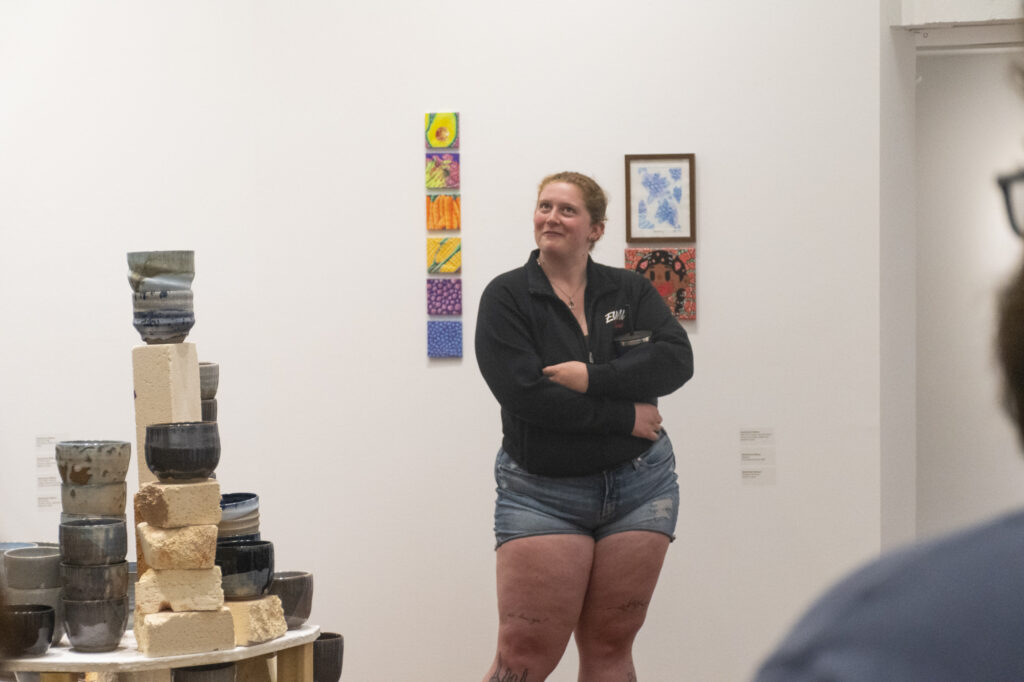
For Consumption, my work is functional pottery cups shown in stacks, on bricks and kiln shelves. These structures reference my family history, academic journey, and self-journey. The stacks reflect my personal experiences with transition, instability, and change, while also referencing the imagery of water which makes me feel at ease and peaceful. The colors mimic nature and the landscape I grew up in, from the blues of the Columbia River to the purples of the Wenatchee valley hills in the spring. I wanted the colors to inspire the viewer to reflect on their surroundings, and the forms to inspire them to reflect on their social and familial landscape.
At the core of my practice is the merging of art and craft, beauty, and utility, strength and fragility. My work is meant to be held, used, lived with, and loved. Each piece carries the imprint of my hands, my history, and my beliefs, and offers the user the opportunity to imbue it with their own history and beliefs.
Rubie Jones:
In consumption, this installation is primarily sculpture. Whether I decide to cast my physical body or not, each one of these pieces have interacted with my body. Putting these items on display I aim to make the viewer uncomfortable and question the voyeuristic nature that female presenting bodies endure. Observation and voyeurism are a crucial part of my work. I allow myself to be put on display, that’s not sexualizing my own body, but showing the natural, messy, and awkward times that are often pushed behind closed doors. I embrace this discomfort because it’s how I feel in my own body at times and allows my work to become more personal and intimate.
With this installation, purity culture and internet trends surrounding women had also become a large influence. The clean girl aesthetic pushes this rhetoric that women should be smaller, quieter, and cleaner, but it’s just the same rhetoric that has been used and reworked and given to a younger demographic. With these trends, it doesn’t allow women to sit with themselves and be stable in their own bodies when the trends are always changing. There is so much more to being a woman that we don’t express or show because of shame, but should because it’s unique, complex and although messy, it’s beautiful. Not giving into these trends, is my own act of defiance against the patriarchy.
Trista Merritt:
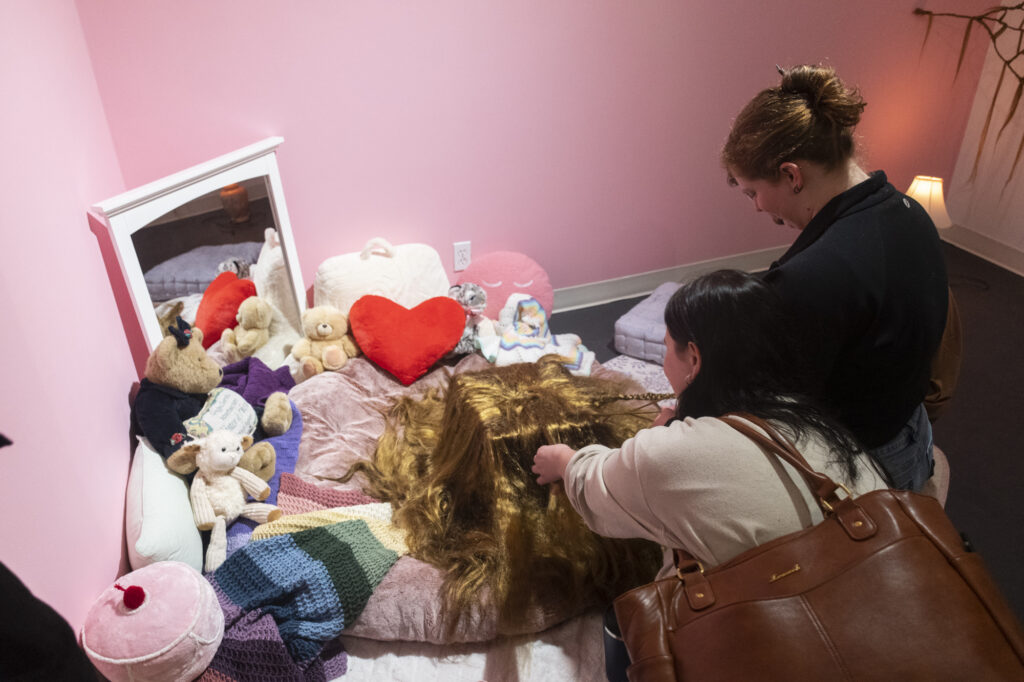
Considering the interfacing or blurring of objects and the body, I work to create sculptural structures and forms enabling an acute awareness within the sensory experience of my audience. Asserting my identity as a queer woman I embrace a “damned if I do, damned if I don’t” principle within my practice. Pushing unapologetic engagements in stereotypical or “objectifying” presentations of gender expression and sexuality. Engaging aesthetics of grotesque beauty, hair becomes a primary material in which I channel questions of personal identity, memory, maternal lineage, and systematic matrices. Reflecting overly sweet, saccharine imagery of hyper-femininity, vibrant candy structures contrast manipulations of hair. Implicating the viewer in an experience of contamination through consumption.
The binding effect of these materials on the viewer’s sensations works to echo cultural and historical aftermaths on female identities as they exist within patriarchal systems. Considering the societal allowance granted to women under these establishments to be “seen and not heard,” veiled behind the walls of domesticity. Within the application of my practice, I aim to confront these themes while simultaneously reinforcing my own presentation and occupation as an unapologetic unpunishable queer woman.
William Simpson:
To reach the masses through the perspectives of the few. One could say that is the primary goal of artistic expression, the internal voice of the creator expressed to the mind’s eye of the viewer. In this, the logic of visual counterculture presents itself. Creating works to be viewed, but without the primary intention of the gallery setting. Rejecting the visual and representational standard the average gallery visitor expects in favor of iconoclastic absurdism. All while still present within the gallery setting, creating an interesting feeling of contradiction. At the core of this is the use of late 20th century visual culture, a time of immense change in technology, popular culture, and the ethics of the world’s socially intractable population. A push and pull of our endless movement forward, countered by them who desired to control the pace. This was expressed extensively in the visual culture of the time in forms of humorous absurdism, role reversal, anachronism, and juxtaposition. I created a pastiche of this time through illustration, cartoons, and animation. I hope to create a sense of connection between viewers that transcends generational cultural barriers, giving a nostalgic feeling towards those who experienced that time, and giving a window of perspective for those who came later.
Nick Tucker:
In a time where we are constantly being inundated with imagery, how often does something right in front of us go unnoticed? How do the collective values of our society affect what people decide is important enough to pay attention to or consider precious? Using various materials and techniques, I play with the idea of the viewer registering the subject as something familiar at first glance but seeing something else if they look closer.
Artwork Descriptions
Zoo-Party System
Combining a donkey and an elephant into one mutated skull, this 8×10 inch drypoint piece represents the two major political parties in our country fighting for power. Driven only by greed, this creature shares the same hinge for both jaws, so one of them is open when the other is shut. This sharing of the jaw is also meant to show that ultimately, they are both saying the same thing, it just sounds different.
Step cut Beetles
Certain insects have developed specific defense mechanisms over time, such as camouflage and mimicry. The concept behind these beetles is to combine something that appears mundane, but could be beneficial, with something that appears beneficial, but could be mundane. Would they be safer or of more value if they were “prettier”?
G2 Profit from 2h4tg
As the cost of living continues to outpace the average person’s wages and it turns out certain individuals can’t be audited by the IRS, I decided to print my own dollar bills at home by hand using the drypoint process. The front of the bill is a “CIRCU.S.” ticket. In each corner of the bill are four rings of the circus, representing a different branch of government. The fourth branch is the media and is represented by a ringmaster’s megaphone. The back of the bill reveals a serpents face that reads, “WE THE PEOPLE OWE LIARS” and in the four corners are symbols representing the corporations/industries most of our money is spent on, such as weapons and pharmaceuticals.
They’re Sycophantastic!
This 16×20 inch multicolor block print is a product advertisement for a boot-flavored lollipop aka Dum Dum (dumb dumb), aka sucker. Act now, they sellout fast!
F(Au)x
This drypoint print/sculpture is a statement about what we choose to place value in and the cost that comes with obtaining it. Each side of the gold bar depicts a different aspect or theme related to the destructive process and history of mining gold. The lokta paper is eco-friendly and renewable, a direct contrast to this damage.
Init Tupractis
This oil painting depicts a beetle that has evolved to mimic something precious to myself, a pen nib. It is a reminder that I can always learn more and we only get better by practicing.
Kolectus Forstatis 1 & 2
Both are depictions of the same ruby beetle, using different materials and scale. The larger piece is a color pencil drawing of the insect as an anaglyph, or 3-D image. The smaller piece is a to scale rendition of the insect using acrylics. Using the anaglyph on the one and scale on the other gets them one step closer to existing in space in their own way.
P(red)ator
At first glance, this piece appears to be an abstraction of colors and marks. If viewed through a blue lens, the abstraction remains. If viewed through a red lens, a tiger skull is revealed. There are things we can’t see if we only view them from one perspective.
Draw More
This is a video collage of digital and physical time-lapse drawings. One drawing starts after another is finished while multiple others are happening at the same time, so depending on which drawing you are paying attention to, the piece could be seen a different way each time the viewer watches it.
Waahinhewin Williams:
My body of work demonstrates the themes of Food Sovereignty with other related themes such as celebration of food, healthy food relationships, community gatherings, Indigenous people’s history and issues, trauma, and environmental justice and sustainability towards the future. I work in 2D mixed media such as drawing, painting, printmaking, digital art, and beadwork. I use a vibrant color palette to make my work approachable and digestible to the content displayed. My work includes my mixed culture identity of being Cherokee on my mother’s side and Indigenous Mexican on my father’s side. Food sovereignty is the people’s right to grow their own food, creating their own agriculture and food systems, and not relying on corporations and the federal government. Throughout this year, I have been telling my personal narrative verbally and artistically. Bead Soup Wings showcases the beginning of my story, with my mother and I rebuilding our wings after going through traumatic events. Avocado, Carrots, Corn, Red Leaf Lettuce, Grapes, Blueberries, Cast Iron Pan 1, 2, and 3 all demonstrate produce and meals that we can all enjoy eating, gathering, and celebrating food together. The Three Sisters, Berry Baskets, Strawberry Ceremony, Blueberry, and Yanasi (Bison) Watches are prime examples of themes with Indigenous people’s history and issues, trauma, and environmental justice and sustainability. Recently, my mother and I have been working on growing food in our garden. My mother is teaching me as I had no prior gardening experience. I learned quickly that gardening takes patience and trial and error. This body of work that I have done so far is only the beginning, my starting foundation. As someone who grew up non-enrolled, disconnected, and urban, I am dedicating my reconnecting life with my communities in any way that I can. I am proud of the work that I do, and I am ready to take this on for several more decades.