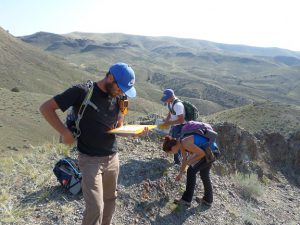
Geosciences Major, Bachelor of Arts (BA)
Geoscience combines social and natural science methods and knowledge to help us understand the complex problems facing businesses, government agencies, and community organizations. Geoscientists are uniquely qualified to investigate issues involving competing land use, complex land management problems, and integrated natural and cultural resource development. Students specializing in geoscience gain exposure to all aspects of the discipline from human and physical geography for their degree and specialize in sub-fields such as GIS, water resources, climate change, carbon budgeting, and other personalized experiences.
Career options may include: GIS, Environmental fields, transportation, energy companies, Governmental regulation and natural resource departments, and public health.
World Language Requirement: Two years of a single high school world language or one year of a single college-level world language is required.
& | DISCOVERING GEOLOGY
and DISCOVERING GEOLOGY LAB | 5 |
| THE EARTH'S CLIMATE AND WEATHER | 5 |
| GLOBALIZATION AND THE ENVIRONMENT | 5 |
| GEOGRAPHIC INFORMATION SYSTEMS I: SPATIAL ANALYSIS FOR SOCIAL SCIENCES | 5 |
| or | GEOGRAPHIC INFORMATION SYSTEMS I: SPATIAL ANALYSIS FOR ENVIRONMENTAL SCIENCES |
& | GEOSTATISTICS
and GEOSTATISTICS LAB | 4 |
| WORKSHOP, SHORT COURSE, CONFERENCE, SEMINAR (variable title and credits) | 1 |
| |
| |
| |
| THE GEOSCIENTIST'S CAPSTONE | |
&
| SENIOR CAPSTONE: WATER AND THE WEST, WATER RESOURCES IN ARID LANDS
and SENIOR CAPSTONE: WATER AND THE WEST, WATER RESOURCES IN ARID LANDS LAB | |
&
| CAPSTONE: ENVIRONMENTAL GEOCHEMISTRY
and CAPSTONE: ENVIRONMENTAL GEOCHEMISTRY LAB | |
| SENIOR CAPSTONE: GEOLOGY FIELD CAMP | |
| SENIOR THESIS | |
| Total Credits | 74-80 |
The following plan of study is for a student with zero credits. Individual students may have different factors such as: credit through transfer work, Advanced Placement, Running Start, or any other type of college-level coursework that requires an individual plan.
Courses could be offered in different terms, checking the academic schedule is paramount in keeping an individual plan current. Students should connect with an advisor to ensure they are on track to graduate.
All Undergraduate students are required to meet the Undergraduate Degree Requirements.
This major requires the completion of the World Language requirement. Students pursuing a Bachelor of Arts (BA) degree must complete two years of a single language in high school or one year of a single language in college.
| First Year |
|---|
| Fall Quarter | Credits | Winter Quarter | Credits | Spring Quarter | Credits |
|---|
| 5 | | 5 | | 5 |
& (Natural Science BACR 1) | 5 | Diversity - graduation requirement1 | 5 | (Natural Science BACR 2) | 5 |
| Humanities & Arts BACR 11 | 5 | Social Science BACR 11 | 5 | Humanities & Arts BACR 21 | 5 |
| | 15 | | 15 | | 15 |
| Second Year |
|---|
| Fall Quarter | Credits | Winter Quarter | Credits | Spring Quarter | Credits |
|---|
| (Social Science BACR 2) | 5 | Geosciences Elective2 | 5 | Geosciences Elective2 | 5 |
| or | 5 | Elective - minor or general elective | 5 | Geosciences Elective2 | 5 |
| Elective - minor or general elective | 5 | Elective - minor or general elective | 5 | Elective - minor, or general elective | 5 |
| | 15 | | 15 | | 15 |
| Third Year |
|---|
| Fall Quarter | Credits | Winter Quarter | Credits | Spring Quarter | Credits |
|---|
| 1 |
& | 4 | Geosciences Elective2 | 5 |
| Geosciences Elective2 | 5 | Geosciences Elective2 | 5 | Geosciences Elective2 | 5 |
| Elective - minor or general elective | 5 | Elective - minor or general elective | 5 | Elective - minor or general elective | 5 |
| Elective - minor or general elective | 5 | | |
| | 16 | | 14 | | 15 |
| Fourth Year |
|---|
| Fall Quarter | Credits | Winter Quarter | Credits | Spring Quarter | Credits |
|---|
| Geosciences Elective2 | 5 | Geosciences Elective2 | 5 | (Senior Capstone - graduation requirement)3 | 5 |
| Elective - minor or general elective | 5 | Elective - minor or general elective | 5 | Elective - minor or general elective | 5 |
| Elective - minor or general elective | 5 | Elective - minor or general elective | 5 | Elective - minor or general elective | 5 |
| | 15 | | 15 | | 15 |
| Total Credits 180 |
University Competencies and Proficiencies
English
Quantitative and Symbolic Reasoning
Placement and Clearance
Prior Learning/Sources of Credit AP, CLEP, IB
General Education Requirements (GER)
- Minimum Credits—180 cumulative credit hours
- 60 upper-division credits (300 level or above)
- 45 credits in residence (attendance) at Eastern, with at least 15 upper-division credits in major in residence at Eastern
- Minimum Cumulative GPA ≥2.0
Breadth Area Core Requirements (BACR)
Humanities and Arts
Natural Sciences
Social Sciences
University Graduation Requirements (UGR)
Diversity Course List
World Language (for Bachelor of Arts)
Global Studies Course List
Minor or Certificate
Senior Capstone Course List
Application for Graduation (use EagleNET) must be made at least two terms in advance of the term expected to graduate (undergraduate and post-baccalaureate).
Use the Catalog Archives to determine two important catalog years.
- The catalog in effect at the student's first term of current matriculation is used to determine BACR (Breadth Area Core Requirements) and UGR (Undergraduate Graduation Requirements).
- The catalog in effect at the time the student declares a major or minor is used to determine the program requirements.
Students who earn a BA in Geosciences from EWU should be able to:
- demonstrate knowledge of human–environment interactions;
- apply geoscience techniques to a complex problem;
- produce a professionally formatted report that effectively communicates;
- demonstrate advanced critical skills in the geosciences in preparation for the professional job market or graduate studies.