Art and Design to Merge
Two closely aligned programs at Eastern Washington University will join forces in a faculty-led effort to create efficiencies and expand opportunities for students.
The new program will share resources and create a synergy for recruiting students, building community partnerships, raising funds and providing applied learning opportunities, according to Mindy Breen, EWU professor and chair of the Design Department, and Jenny Hyde, director of art and chair of EWU Fine & Performing Arts.
“It’s going to be positive all across the board for our students and will help with the two programs becoming stronger,” says Hyde, adding that the move could lead to additional career options for students.
Over the years, the programs have found themselves offering similar courses, such as photography and illustration, on two different campuses.
“When it comes to designing curriculum, we’re often running into each other because we often overlap in a lot of different areas,” Hyde says. “So, there was a curriculum discussion, and it became apparent that this was the right time to make this happen.”
Breen says another factor is the university’s focus on dedicating space in the Catalyst building, where upper-level design courses are currently housed, to EWU health science and certain C-STEM programs.
“It will free up space for the programs moving in, and it gets us back to campus to start this new phase of our existence,” says Breen, who looks forward to having all the design courses and the program’s students and faculty located in Cheney.
Although the two programs share core language and similar skillsets, they are housed within different colleges. Art resides in the College of Arts, Humanities and Social Sciences (CAHSS) while design is housed in the College of Science, Technology, Engineering and Mathematics (CSTEM).
Nonetheless, when Breen and Hyde went to Michelle DenBeste, dean of CAHSS, and Jennifer Waldo, interim dean of CSTEM, both leaders were supportive, as was university leadership.
“This collaboration reflects exactly the kind of mission-aligned innovation we need at Eastern Washington University,” says Provost Lorenzo Smith. “By reducing unnecessary duplication and intentionally sharing expertise and space, we strengthen academic quality while expanding applied learning opportunities for our students. When faculty lead thoughtful efforts like this—grounded in student success and responsible stewardship—it positions both programs to grow, adapt, and better serve the region.”
The two deans highlighted multiple ways the merger will benefit both art and design students.
Waldo says the move “provides students with greater access to the talents, experiences and connections of the faculty in both programs” as well as “greater access to shared resources.”
DenBeste agrees, saying the integration will make it easier for students to take courses across both disciplines and realize more choices. Faculty will also benefit from collaboration and shared facilities, she says.
“Whatever happens with the choice of college, I am really excited about the opportunity for our art and design programs to work together,” DenBeste says. “We have amazing faculty in both art and design, and I’m looking forward to working with all of them.”
Art and design shared a degree about a decade ago, Breen points out, adding that the shared degree program was “fun and collaborative.” It was created because many students were double majoring, she continues.
“It’s an example of our shared history, and this move back to Cheney to merge with art feels like we’re finishing something we started years ago,” Breen says. “It feels like it’s coming full circle – and that’s a good feeling.”
The timeline for the merge is as follows:
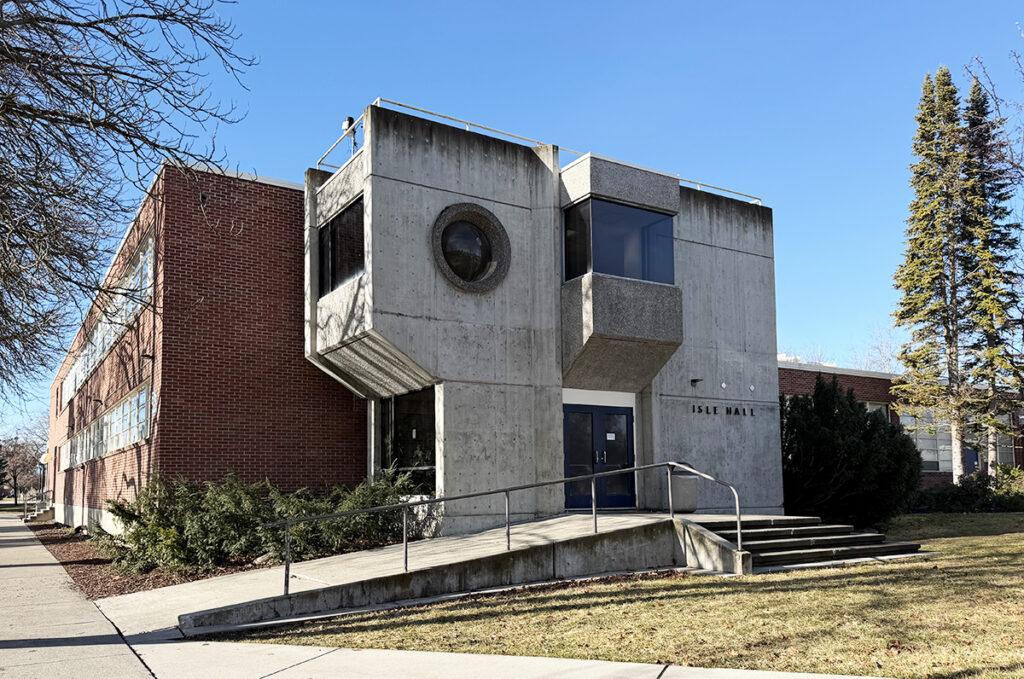
Summer 2026: Design moves from Catalyst to Isle Hall in Cheney.
Fall 2026: Design begins offering all classes on the Cheney campus.
Fall 2027: Submit curricular changes for approval. Finalize college and administrative piece.
Fall 2028: Approved curricular changes go into effect.
The program integration will proceed in accordance with university policy AP 301-01, which includes faculty engagement, governance, review and approval.
Waldo says leadership of both colleges are collaborating to get space needs ironed out and identify necessary renovations for the move this summer.
“It is a great privilege to be able to facilitate the implementation of an initiative that springs from faculty members that think deeply about ways to problem solve while centering student success and opportunity,” Waldo says. “Their work provides an incredibly important model for our students and is a showcase for applied learning in action – putting your skills to use in new and important contexts.”

Find EWU faculty and staff who are experts in diverse subjects.