EWU Course Supports Teachers in Crisis Zones
For children and young adults living in areas affected by armed conflict and natural disasters, the barriers to learning are real and persistent: classrooms damaged, lessons interrupted, families displaced.
At Eastern Washington University, English as a Second Language (ESL) scholars are teaming up with international educators to help, offering “global classrooms” that provide the techniques and strategies teachers need to keep their students engaged and on track.
At the heart of the effort is a course developed by Gina Petrie, a professor and English as a Second Language program coordinator at EWU. Findings on the impact of some of the strategies taught in that course, “Trauma-Sensitive Teaching for English Teachers,” were recently published in an October special issue of Oxford Academic’s ELT Journal.

The article was the brainchild of one of the course’s most successful practitioners. Valeriia Sichka is a 25-year-old teacher who, up until recently, lived and taught in Southwest Ukraine’s Zakarpattia region. While still in her war-torn homeland, Sichka, sought a way to support her students through the hardships of the conflict by enrolling in the 8-week Trauma-Sensitive Teaching course created by Petrie.
She went on to apply those trauma-sensitive strategies with students she taught at Uzhhorod National University, and later collaborated with Petrie and Janine Darragh, a literacy and ESL professor at University of Idaho — who is currently the lead teacher of the class — on the ELT Journal article.
Sichka is proud that what began as an idea “through time, dedication and teamwork” resulted in a powerful article published in an international journal.
“I hope this article will encourage people to learn more about SEL, trauma-sensitive teaching and mindfulness, and apply these practices not only in education, but also in their daily lives.”
Impact Multiplied
Funded by the U.S. State Department, the EWU class is now in its eighth academic session. Since launching in 2023, it has enrolled 210 teachers from Pakistan, Ethiopia, Kenya, Serbia and other countries, with most participants living and teaching in Ukraine, Petrie said.
“I’ve learned a lot about what crisis situations can look like,” Petrie said. “It can look like schools wiped out by hurricanes. It can look like ongoing wars. It can look like refugee camps.”
Keeping students connected to school in such places, she continues, restores a sense of routine that helps families rebuild. English language skills can be an especially helpful part of that rebuilding process, since a knowledge of English not only boosts students’ long-term career options but is also useful in potential dealings with international relief crews.
Most of all, Petrie said, keeping classes going amid chaos helps students continue to move forward: “You are dreaming of their future – and you don’t want them to get behind.”
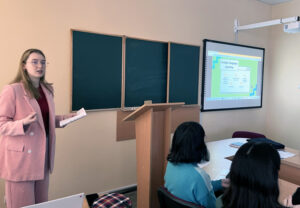
Sichka and her students, typically ages 19–22, endured incredible hardships – including the loss of loved ones. Russian missile attacks on critical energy grids in neighboring regions resulted in frequent orders to shelter and rolling blackouts. “I still remember sitting in a completely dark, cold room in the evening with only a small lamp and my laptop powered by a portable generator, trying to conduct at least a few classes,” she said.
Sichka used WhatsApp to connect with students. WhatsApp, with its free instant voice and video messaging system, is a “low‑resource” strategy recommended in the EWU course.
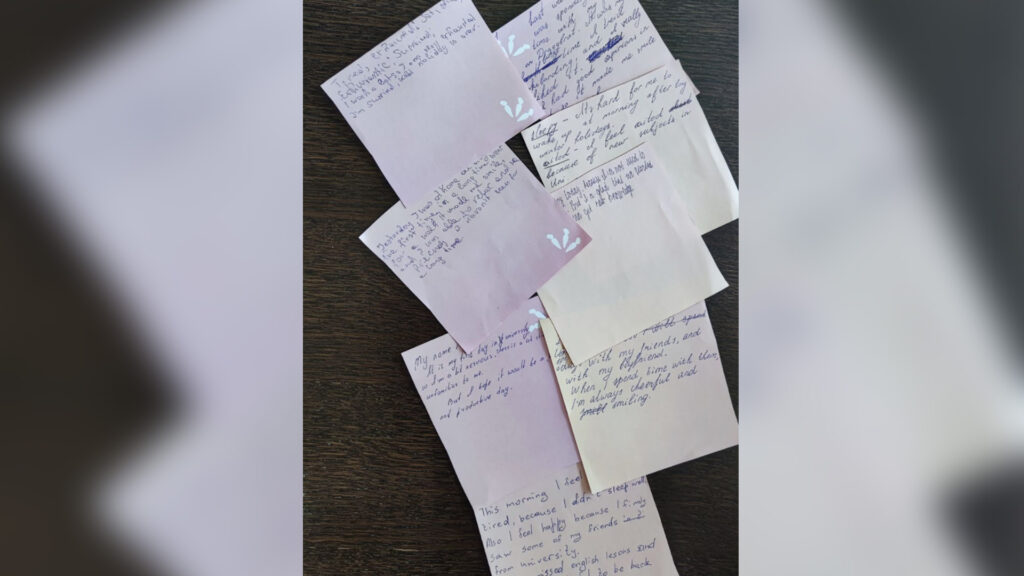
Sichka created activities focused on sharing experiences, building resilience and expressing gratitude. The activities became a form of storytelling that helped students learn to express themselves in English while also fostering a sense of camaraderie among the students.
For the sharing experiences activity, students were asked questions about recent events and their subsequent feelings. Building resilience encouraged students to share stories about how they reacted to adversity and how they felt afterward.
When the activity focused on gratitude, students were asked to reflect on whom they were grateful for in their lives and why. Sichka played calming music and guided students through a brief meditation to help them focus and momentarily distance themselves from the constant rush, because otherwise, not all students could experience a state of being calm and relaxed amid such a difficult daily routine, she said.
After each activity, students provided a rating from 1-to-5, with one being the lowest rating and 5 being the highest, and explained their responses. Most reported feeling calmer, more relaxed and more connected to classmates.
A larger survey reflecting students’ overall experience found that 89% wanted to participate in similar activities in the future. Students said they enjoyed the activities, found them useful for their emotional and mental health, and thought they also helped them develop their English language skills.
One student wrote, “These activities are great, because they encourage me and my colleagues to share ideas and talk to each other about important things.”
EWU Making a Difference Internationally
EWU has long worked with teachers from conflict zones, beginning with English language programs for Iraqi educators in 2008. Petrie developed the trauma-sensitive course after a request for proposals from FHI 360, a University of North Carolina-based nonprofit that manages online programs for the State Department’s Bureau of Educational and Cultural Affairs. She structured the course around online interviews with EWU experts — faculty members such as Bipasha Biswas, Russell Kolts and Suzie Henning — who shared their insights into the nature of teaching and learning under duress.
“People all across our campus, they are a part of the shape of that,” Petrie said.
Petrie also partnered with Spokane’s Barton English Language School to feature ESL students who themselves had lived through crises for “Listen to a Learner” modules. (Here is a link to a lesson module created in partnership with Barton English Language School and it’s students.)
“They talk about a strategy that was covered in that course; one that they put into action and what impact it made for them in healing,” Petrie said. “So, it’s very empowering.” EWU’s course has had a ripple effect, Petrie adds, with Sichka and other Ukrainian teachers creating and sharing their own curricula.
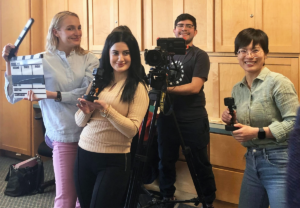
Now living in Chile, Sichka continues teaching and mentoring students who live in Ukraine and are scattered as refugees across Europe, helping them advance their skills and become confident English speakers as they adjust to new cultures, workplaces and academic demands. They have become like family, she said.
Sichka hopes the publication of her paper will encourage other educators to learn more about social-emotional learning, trauma-sensitive teaching and mindfulness.
“Trauma-sensitive teaching and SEL will not stop conflicts and wars. It will not stop natural disasters or cure diseases,” the article concludes. “But incorporating trauma-sensitive practices and SEL into our own English classrooms is one small way we can take control of the uncontrollable. It is a way that we can provide a respite for our students (and ourselves) in our learning spaces, where together we can think, grow, and dream of a better and brighter future.”

Find EWU faculty and staff who are experts in diverse subjects.