EWU to Host Wheelchair Basketball Tournament
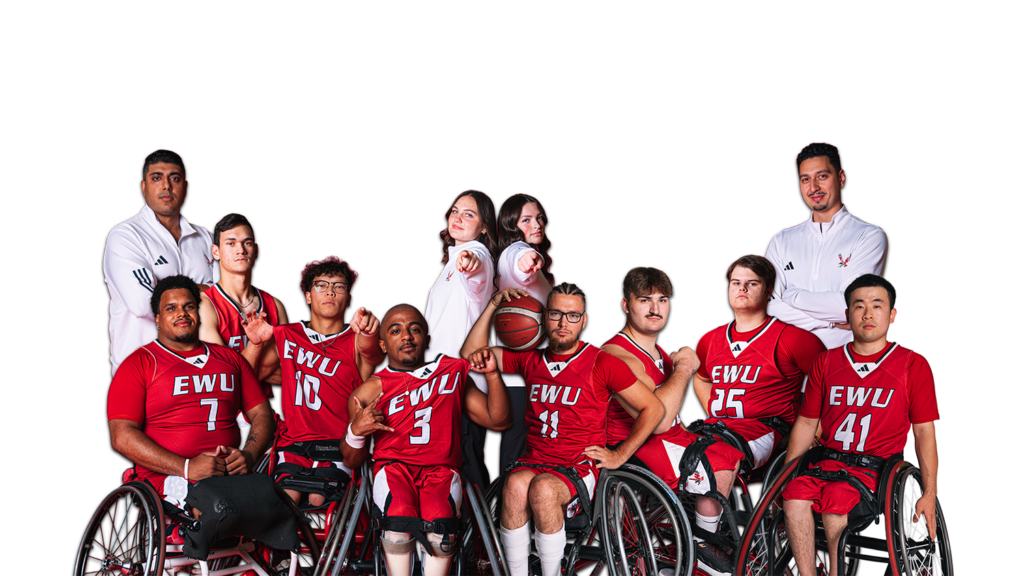
Eastern Washington University’s wheelchair basketball team, one of only 13 collegiate teams in the nation, hopes Eagle fans will pack Reese Court this weekend for an EWU-hosted tournament featuring top teams from the western United States.
This weekend’s competitors will include University of Arizona Wildcats, the reigning Intercollegiate Division national champions, as well as Oregon’s Bridge City Rolling Blazers and the Utah Wheelin’ Jazz, a highly competitive D-1 team with athletes who’ve played full college careers, including several who also have Team USA experience.
“It’s going to be a pretty competitive tournament this year,” said Eagles’ Head Coach David Evjen.
The event will held Saturday and Sunday, Oct. 25 and 26. Saturday’s games will tip-off at 10 a.m., while Sunday’s matchups begin at 9 a.m. Admission is free thanks to partnerships with sponsors that include MultiCare, PER4MAX, Spokane Hoopfest Association and Waddell’s Neighborhood Pub.
With over 25 combined years of experience in adaptive athletics, Evjen and assistant Yunus Butt are proud to lead the only intercollegiate team in the Pacific Northwest. They’re even more proud, they say, that wheelchair basketball has found a home at EWU. (Learn more about EWU’s program online.)
“Out of all the schools that the original task force presented to start an adaptive athletics program, Eastern was the only one that was willing to do it,” Butt said.
Organized wheelchair basketball got its start in 1946 and made its Paralympic debut in 1960.
Even so, the sport is a relatively recent addition to the world of collegiate athletics, and wheelchair basketball teams from across the country often must organize their own “game weeks,” typically with a handful of teams participating.
The idea, said Butt, is to build exposure and respect for the game: “We want people to come and to show them how competitive the sport is.”
Some 600 fans attended last year’s home games at Reese Court. Both coaches and players say the excitement of wheelchair hoops has the potential to one day pack the stands.
“We’re here to compete. We’re here to show out and show off,” said Liam Frobisher, a senior team member who hopes to continue playing on a competitive level after graduation. “Don’t underestimate us. Don’t count us out.”
Frobisher, who has played wheelchair basketball since he was 12, said his love for the game came early thanks to the coaches and players who saw his potential.
“They didn’t see me as a wheelchair basketball player or as an athlete in a wheelchair,” he said. “I was just an athlete, and so I fit right in.”
Another of the team’s players, Ben Belino, got his start playing for ParaSport Spokane during his senior year of high school. Belino, a stand-out track and field athlete in addition to a competitive hoops player, acts as a “big,” or a forward, on Eastern’s team. He says he wants potential fans to understand that the wheelchair game is no different from able-bodied sports.
“We play on regular, able-bodied hoops,” said Belino, who is now a sophomore at EWU “We follow very similar rules as able-bodied [players].”
Evjen said that Eastern’s Wheelchair Basketball program is a draw for talented para-athletes who want to play as they earn their degrees. For some, it tips the scale.
“Our program had a huge influence on many of our athletes’ decision to attend Eastern,” Evjen said.
Butt said, “Every single person on this team is proud of their disability,” adding that “disability is not a bad word.”
Evjen, who has the perspective of being both player and coach in wheelchair basketball competitions, said it is often the nuances of everyday life, including convenient access to buildings, that go unnoticed by the able-bodied community.
For example, there is currently no indoor elevator in the Physical Education Building, where the team holds its practices. As a result, players go from practicing on a third-floor court to needing to exit and reenter the building for workouts in the weight room, which is on the first floor.
“You start noticing what things could be better. Doorways could be a little bit wider. You start to learn those things, so then you can start advocating better,” Evjen said.
Tournaments like this weekend’s competition are a great opportunity for people who have never seen wheelchair basketball – or other parasports – to experience what they’re missing, Evjen said.
We want more people that are first-time viewers of the game to come with open minds,” he said. “The goal is if someone comes for the first time, hopefully, by the end of it, they are watching the game itself and not the equipment that’s used to play.”
The full tournament schedule is available online.
**Story written by Rachel Weinberg.

Find EWU faculty and staff who are experts in diverse subjects.