EWU’s New Residence Hall Project Takes Shape
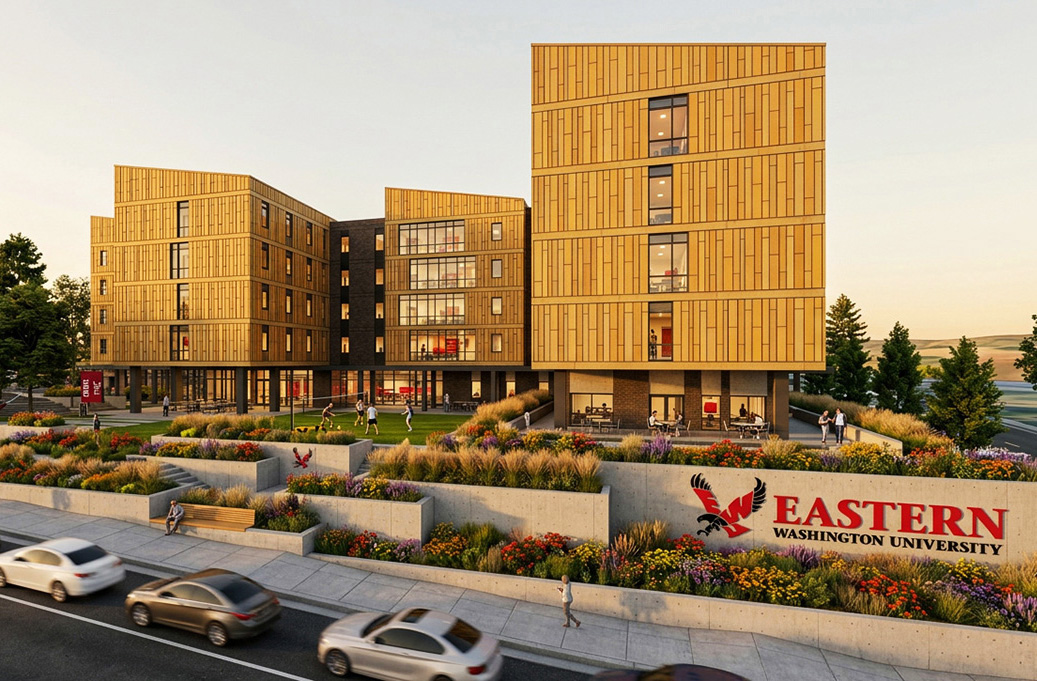
Plans for Eastern Washington University’s new Dryden Hall are taking shape, with design of the new building coming into sharper focus and the project proceeding on time and on budget.
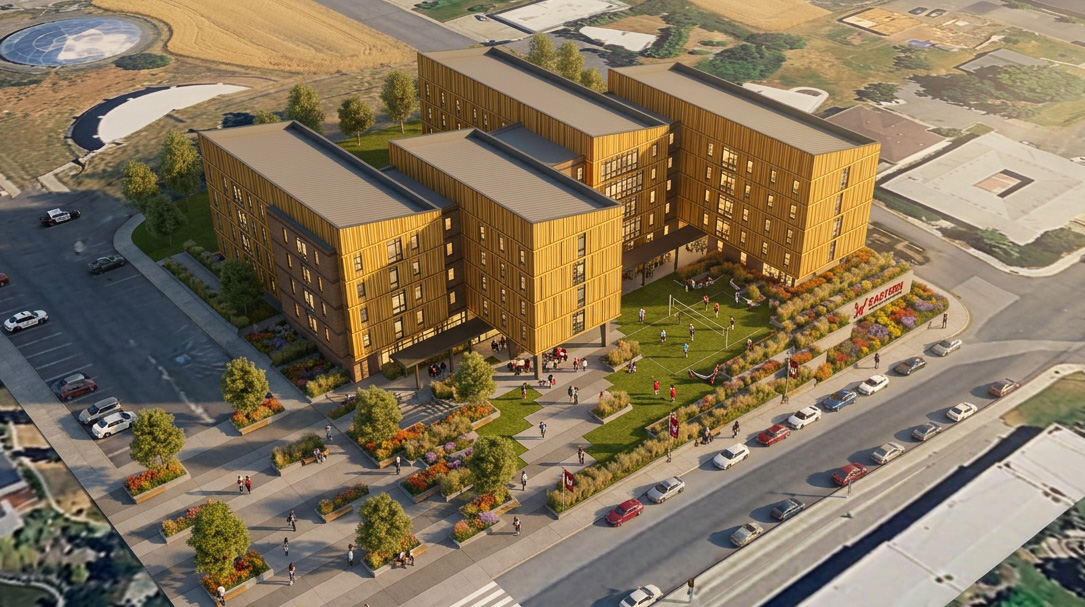
Construction of the five-story, 392-bed residence hall is expected to start early next year at the northwest corner of Ninth Street and Cedar Street, with completion of the $50.2 million project scheduled in advance of the 2028-29 school year.
To make way for the new hall, demolition of the 61-year-old, long-shuttered Dryden Hall is expected to start next month. Already, some site work and interior demolition are underway.
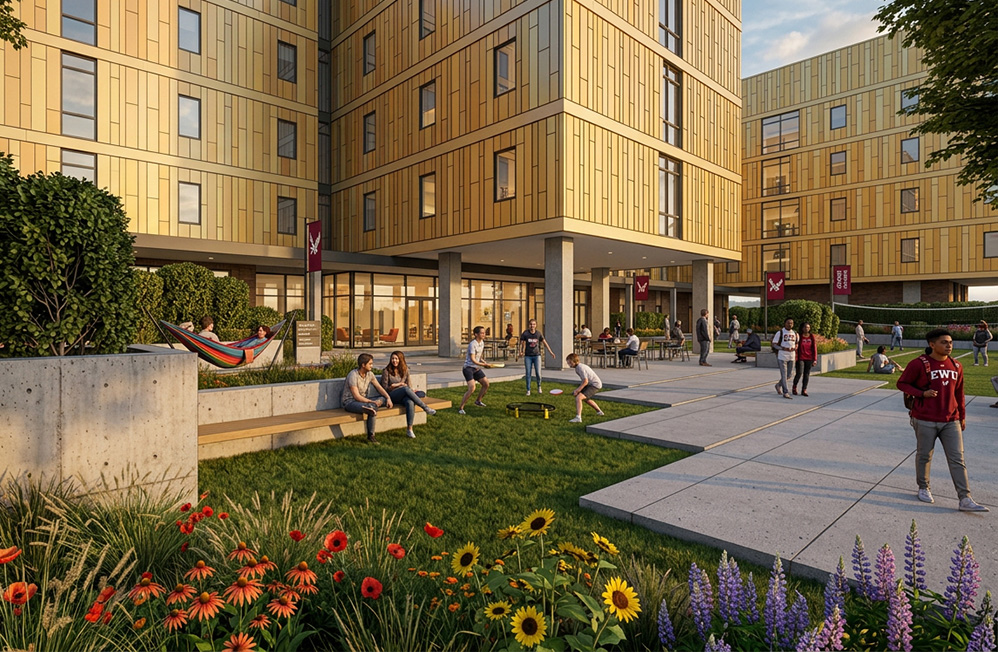
Melanie Potts, EWU’s director of housing and residence life, says the building is being designed to promote community and to provide amenities that are important to students.
“Students have expressed a desire for welcoming common areas, more private bathrooms, and kitchen space in which they can prepare their own food,” Potts says.
“The new Dryden Hall will have the amenities that are most important to our students,” Potts says. “We’re confident this building will promote a sense of belonging that has the potential to translate to improved academic outcomes.”
NAC Architecture is designing the residence hall to achieve silver-level certification in the U.S. Green Building Council’s Leadership in Energy and Environmental Design (LEED) building rating system. To attain silver LEED status, the project is being designed to place a priority on water efficiency, indoor environmental quality, energy and atmosphere, and other factors.
“This project will be one in a series of projects that place an emphasis on sustainability and energy efficiency on campus,” says Kris Jeske, associate vice president of facilities. “That focus will be good for the environment and will save the university a substantial amount of money in energy costs over the life of the building.”
For the new structure, EWU is retaining the Dryden Hall name. The original structure was named after Cecil Pearl Dryden, an influential history professor and prolific writer who taught at EWU for more than 30 years and authored more than a half-dozen books during her career.
“Eastern Washington University has the distinction of having many trailblazing women throughout its history,” says Lea Jarnagin, vice president of student affairs. “It’s important that we continue to honor women like Cecil Dryden, who helped to make EWU the great place it is today.”
The residence hall project is among nearly $250 million in capital improvements recently completed, envisioned in the future, or in some stage of development at EWU. Other projects include:
- A $110 million Science Building expansion and renovation that was completed last month.
- An envisioned, $25 million Lucy Covington Leadership Center for which EWU will seek state funding in upcoming Legislative sessions.
- A $12 million renovation of spaces in the Catalyst and SIERR buildings in the Spokane University District to create a health sciences hub. The dental hygiene program will move into its new space at the beginning of the year, with other improvements continuing into 2027.
- A total of $17 million in energy upgrades, including plans to install a 1.4-megawatt solar array on the southwestern portion of campus, near the athletic practice fields, and other measures intended to shrink EWU’s environmental footprint and increase its energy independence.
- An $8 million second phase of renovations at Roos Field that will add a press box above the eastern grandstands, clearing the way to create more fan amenities on the west side of the stadium. That project will get underway next year and is slated to be completed in advance of the 2028 football season.
- Significant projects that involve interior improvements, including improvements at Isle Hall to accommodate programs moving to the Cheney campus from Spokane.
EWU President Shari McMahan says, “The way students live, learn, and connect with one another continues to evolve. We’re making thoughtful investments in our campus that support what students need today, while also preparing for those who will call Eastern home for generations to come.”

Find EWU faculty and staff who are experts in diverse subjects.