Bachelor of Science in Mechanical Engineering

Transform Ideas Into Innovation

With EWU’s Bachelor of Science in Mechanical Engineering, you’ll gain the expertise and credentials to turn big ideas into real-world solutions.

Our ABET-accredited program provides valuable knowledge and skills that employers value, while also guiding you toward earning a Professional Engineer (PE) license.

In the first two years of the program, you’ll study robotics, automation, thermodynamics, fluid mechanics, materials, and more to build a solid foundation in math, science, and engineering principles. In your third and fourth years, you’ll explore advanced topics and tackle a senior-year capstone project for practical experience.

By the time you graduate, you’ll be prepared for careers in aeronautics, biomechanics, energy, structural design, and various other fields. You can lead teams, solve complex problems, and make a significant impact in the world of engineering.

The Bachelor of Science in Mechanical Engineering is accredited by the Engineering Accreditation Commission (EAC) of ABET, under the General Criteria and the Mechanical Engineering Program Criteria.

2017-182018-192019-202020-212021-222022-232023-242024-25
Majors176157140118859077178
Pre-Majors1241391367954503112
Graduates7181667751365427

Ready to Declare?

Declare your major as Mechanical Engineering by completing the major declaration form.
Request Info Curriculum & Requirements Learning Outcomes

Why Study at the Region's Polytechnic?

Get a hands-on education, real-world experience, and personalized support from faculty so you can launch your career with confidence.

Academic Excellence

Academic Excellence

We are a 2025-26 Engineering College of Distinction.

Top-Rated Robotics Program

Top-Rated Robotics Program

Gain cutting-edge skills in automation and robotics.

Career Connections

Career Connections

Tap into a network of top regional employers like Boeing and Lamb Weston.

Industry-Experienced Faculty

Industry-Experienced Faculty

Get real-world insights from experts who’ve worked in the field.

Where Mechatronics Happens

Where Mechatronics Happens

Learn at the intersection of mechanics, electronics, and computing.


EWU Mechanical Engineering and Technology

"The supportive faculty, collaborative atmosphere, and exposure to cutting-edge technology makes EWU an excellent place to develop the skills needed to be a successful engineer." – Lauren McCauley

What You'll Learn

The following information comes from the official EWU catalog, which outlines all degree requirements and serves as the guide to earning a degree. Courses are designed to provide a well-rounded and versatile degree, covering a wide range of subject areas.

Applied Learning Opportunities

  • Applied Laboratory Work: Build practical, career-ready skills by working in labs that mirror professional lab environments.
  • Classroom-Based Applied Learning/Simulation: Practice decision-making through simulations, case studies, and other hands-on activities in the classroom.
  • Internships: Get real-world experience (and often credit or pay) by working in a professional setting connected to your career goals.
  • Service-Learning Experiences: Work on critical issues—such as food security, poverty, or climate change—that connect community service with what you’re learning in class.
  • Undergraduate Research: Collaborate with professors on research projects where you ask questions, solve problems, and present what you discover.
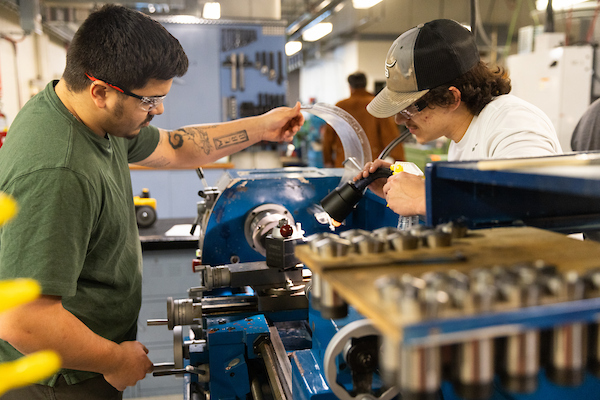
Two students collaborate on a project in the Engineering Foundry

Student Outcomes

Upon graduation from the EWU Mechanical Engineering Program, students are expected to have:

  • an ability to identify, formulate, and solve complex engineering problems by applying principles of engineering, science, and mathematics.
  • an ability to apply engineering design to produce solutions that meet specified needs with consideration of public health, safety, and welfare, as well as global, cultural, social, environmental, and economic factors.
  • an ability to communicate effectively with a range of audiences.
  • an ability to recognize ethical and professional responsibilities in engineering situations and make informed judgments, which must consider the impact of engineering solutions in global, economic, environmental, and societal contexts.
  • an ability to function effectively on a team whose members together provide leadership, create a collaborative environment, establish goals, plan tasks, and meet objectives.
  • an ability to develop and conduct appropriate experimentation, analyze and interpret data, and use engineering judgment to draw conclusions.
  • an ability to acquire and apply new knowledge as needed, using appropriate learning strategies.

Program Educational Objectives

EWU Mechanical Engineering graduates should be able to do the following a few years after graduation:

  • Solve a wide range of applied engineering problems using what they learned both in school and after graduation.
  • Find the information they need in order to develop problem solutions.
  • Lead projects and small teams by serving as a liaison between the more technical and applied aspects of engineering and manufacturing.
  • Use their skills as an Engineering Professional to benefit society in whatever career path they choose.