Bachelor of Arts in Social Work

Make a Meaningful Impact

Eastern Washington University offers a full-time Bachelor of Arts in Social Work (BASW) degree that can be completed in two years. You can choose the path that best fits your life: an on-campus BASW or an online BASW.

On‑Campus BASW: Engage in a collaborative, cohort‑based learning experience with daytime classes held at our Cheney campus. Social work classes are scheduled in 2- to 4-hour blocks and, depending on the quarter, are held 2 to 4 days per week, usually beginning at 8 a.m. Please note that the core curriculum is not offered in the evening. Electives are available during the day on the Cheney campus, in the evening, or online.

Online BASW: Earn your degree from anywhere in Washington with online coursework designed for working adults, caregivers, and place‑bound students. The online format is ideal for students living outside the Spokane/Cheney region, community college graduates seeking a seamless transfer pathway, or anyone who requires flexibility. Practicums will be completed in person at the student’s local community. Please note that additional fees may apply for the online BASW. Get more details here.

Field education (practicum) lasts for three quarters and starts in the fall of the second year. Our practicum placement process is highly structured, and students are placed based on the right fit. We work closely with students and partnering agencies to ensure learning goals are met.

If you have any questions, please contact the School of Social Work.
Admissions Info

Mission of the BASW Program

The BASW program at Eastern Washington University School of Social Work prepares competent, evidence-informed social workers to be agents of change serving client systems from local to global levels. This is accomplished through experiential learning and critical thinking, guided by the social work profession’s values, including social justice and human dignity.

Admissions

Students must be admitted to EWU and be admitted to the Bachelor of Arts in Social Work Program.

  1. A minimum GPA of 2.5 is required to apply.
  2. Applicants must have earned a minimum of 80 college credits.
  3. Applicants must have no more than two EWU required courses or DTA courses to be completed at the time of their application.
  4. Courses that are in progress during the spring quarter in which the student is applying may be counted toward meeting the preceding criterion.
  5. Applicants must have completed English 201 or an equivalent course at another college or university with a minimum grade of 2.0 or C at the time of their application.
  6. Applicants must have completed intermediate algebra with a minimum grade of 2.0 at the time of application.
  7. Previous Life or Work Experience cannot be substituted for course credit.
  8. Applicants must provide two professional or academic references. One reference must be from an individual who has supervised the applicant’s work for 40 hours or more.

Please contact Bipasha Biswas at 509.359.4247 or bbiswas@ewu.edu if you have any questions about criteria for admission.

Applicants must have either one of the following:

  1. A completed Direct Transfer Agreement (DTA) from a community college in Washington, an Associate of Arts Oregon Transfer (AAOT) from a community college in Oregon or a transfer degree from specific community colleges in Idaho and Montana. View the list of degrees that meet the DTA requirements.
  2. Those who have not completed a transfer degree and/or who are transferring from another university/college must have their credits evaluated on a course-by-course basis for approval of admission for the following requirements:
    1. A minimum of 80 College Credits
    2. Intermediate Algebra with a grade of 2.0
    3. English College Composition; Analysis, Research and Documentation with a grade of 2.0 or C
    4. Two years of high school or one year of college foreign language

Applications open February 9, 2026, for the Fall 2026 start date. Review of applications will begin on April 1, 2026. The application deadline is August 14, 2026.

Transfer students must apply to EWU before they can apply to the BASW Program.

Application Materials to Submit 

A completed BASW application including the following items:

1. Unofficial transcripts from all postsecondary institutions attended

2. A BASW Program Eligibility Checklist 

3. A BASW personal statement

Address in no more than 1, 200 words and no less than 350 words:

  • What is your primary reason for wanting to become a social worker?
  • What previous accomplishments of yours best prepare you to be a social worker?
  • What will be your greatest challenge in meeting the demands of the BASW Program, including full-time coursework and 16 hours a week of practicum (during the second year of the Program) and what is your plan to address this challenge?

4. Email addresses from at least two (2) and no more than three (3) references:

One must be from someone who has supervised your work for at least 40 hours, such as an employment supervisor or volunteer activity supervisor

Other references may be from faculty members – high school teachers are acceptable, coaches, civic or academic club sponsors, such as science or chess club or gay-straight student alliances

References shall not be from family members, family friends, personal friends or romantic partners, clergy other than those who were your supervisors, personal therapists, counselors or recovery program sponsors

5. If applicable, a brief statement about how an applicant shall complete the requirement that no more than three EWU or DTA required classes shall be outstanding by the end of the summer quarter.

Apply to the BASW Program


Download the Application Instructions PDF. If you have questions about the BASW Program admission requirements or how to meet them, please contact:

Bipasha Biswas
Professor/BASW Program Director
Senior Hall 102 (Office: SNR 332)
E: bbiswas@ewu.edu

Applied Learning Opportunities

  • Classroom-Based Applied Learning/Simulation: Practice real-world decision-making through simulations, case studies, role playing, and other hands-on activities in the classroom.
  • Practicums: Build your skills in structured field placements—like classrooms, clinics, or community agencies—that are often required for professional certification.
  • Student Employment & Leadership at EWU: Gain skills, connections, and confidence through on-campus jobs and leadership roles in student government, departments, athletics, or clubs.
  • Undergraduate Research: Collaborate with professors on research projects where you ask questions, solve problems, and present what you discover.
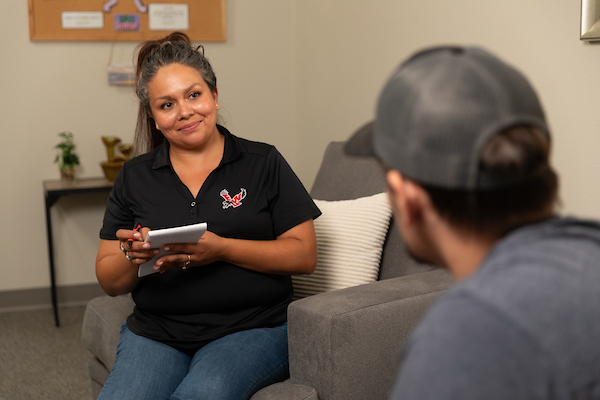
A counselor talks with a patient in a room

What You'll Learn

The following information comes from the official EWU catalog, which outlines all degree requirements and serves as the guide to earning a degree. Courses are designed to provide a well-rounded and versatile degree, covering a wide range of subject areas.

Social Work Major, Bachelor of Arts (BA)

BASW Program Options

Eastern Washington University School of Social Work offers a full-time Bachelor of Arts in Social Work (BASW) degree that can be completed in two years. Students can choose the path that best fits their life: an on-campus BASW or an online BASW.

On‑Campus BASW: Engage in a collaborative, cohort‑based learning experience with daytime classes held at our Cheney campus. Social work classes are scheduled in 2- to 4-hour blocks and, depending on the quarter, are held 2 to 4 days per week, usually beginning at 8 a.m. Note that the core curriculum is not offered in the evening. Electives are available during the day on the Cheney campus, in the evening, or online.

Online BASW: Earn the BA degree from anywhere in Washington with online coursework designed for working adults, caregivers, and place‑bound students. The online format is ideal for students living outside the Spokane/Cheney region, community college graduates seeking a seamless transfer pathway, or anyone who requires flexibility. Practicums will be completed in person at the student’s local community. Note that additional fees may apply for the online BASW. Get more details here.

World Language Requirement: Two years of a single high school world language or one year of a single college-level world language is required.

Grade Requirements: Social Work courses and support courses with a grade <C are not acceptable for graduation.

Required Courses
SOWK 273INTRODUCTION TO SOCIAL WORK5
SOWK 378THEORIES OF HUMAN BEHAVIOR IN DIVERSE ENVIRONMENTS4
SOWK 381REFLECTIVE PRACTICES IN SOCIAL WORK4
SOWK 459 THEORIES FOR APPLIED PRACTICE WITH INDIVIDUALS, FAMILIES, AND GROUPS4
SOWK 464SOCIAL WORK CASE MANAGEMENT4
SOWK 467SURVEY OF SOCIAL WELFARE POLICY4
SOWK 468USE OF RESEARCH IN SOCIAL WORK4
SOWK 469UNDERSTANDING DATA IN SOCIAL WORK4
SOWK 470SOCIAL ACTION TO CHANGE PROGRAMS AND PRACTICES4
SOWK 473SOCIAL WORK IN ORGANIZATIONS4
SOWK 476SOCIAL WORK ENGAGEMENT AND ASSESSMENT WITH INDIVIDUALS AND FAMILIES4
SOWK 477SOCIAL WORK WITH COMMUNITIES4
SOWK 479SOCIAL WORK WITH GROUPS4
SOWK 480FIELD PREPARATION1
SOWK 482BASW PRACTICUM AND SEMINAR (1-6 variable credit course–must be repeated three times)15
Required BASW Elective - choose any 300 or 400 level SOWK, DSST, CDST or ADST course3-5
Required Capstone
SOWK 490SOCIAL WORK SENIOR CAPSTONE4
Total Credits76-78

The following plan of study is for a student with zero credits. Individual students may have different factors such as: credit through transfer work, Advanced Placement, Running Start, or any other type of college-level coursework that requires an individual plan.

Courses could be offered in different terms, checking the academic schedule is paramount in keeping an individual plan current. Students should connect with an advisor to ensure they are on track to graduate.

All Undergraduate students are required to meet the Undergraduate Degree Requirements.

This major requires the completion of the World Language requirement. Students pursuing a Bachelor of Arts (BA) degree must complete two years of a single language in high school or one year of a single language in college.

First Year
Fall QuarterCreditsWinter QuarterCreditsSpring QuarterCredits
ENGL 1015MATH 1075ENGL 2015
Humanities & Arts BACR 115Social Science BACR 115Humanities & Arts BACR 215
Natural Science BACR 115Elective - minor or general elective5Social Science BACR 215
 15 15 15
Second Year
Fall QuarterCreditsWinter QuarterCreditsSpring QuarterCredits
Natural Science BACR 215Diversity - graduation requirement15Global Studies - graduation requirement15
Elective - minor or general elective5Elective - minor or general elective5Elective - minor or general elective5
 15 15 15
Third Year
Fall QuarterCreditsWinter QuarterCreditsSpring QuarterCredits
SOWK 2735SOWK 4674SOWK 4644
SOWK 3784SOWK 4684SOWK 4694
SOWK 3814SOWK 4764SOWK 4801
Elective - minor or general elective4Elective - minor or general elective5Social Work Elective24
 17 17 13
Fourth Year
Fall QuarterCreditsWinter QuarterCreditsSpring QuarterCredits
SOWK 4594SOWK 4704SOWK 4774
SOWK 4794SOWK 4734SOWK 4825
SOWK 4825SOWK 4825SOWK 490 (Senior Capstone - graduation requirement)4
 Elective - minor or general elective4 
 13 17 13
Total Credits 180
1

University Graduation Requirements (UGR) and Breadth Area Course Requirements (BACR) courses may be less than 5 credits and additional credits may be required to reach the required 180 total credits needed to graduate.  Students should connect with an advisor to ensure they are on track to graduate.

2

Required BASW Elective - choose any 300 or 400 level SOWK, DSST, CDST, or ADST course, 3-5 credits.

Students who earn a BA in Social Work from EWU should be able to: 

  • Demonstrate Ethical and Professional Behavior.
  • Advance Human Rights and Social, Racial, Economic, and Environmental Justice.
  • Engage Anti-Racism, Diversity, Equity, and Inclusion (ADEI) in Practice.
  • Engage In Practice-informed Research and Research-informed Practice.
  • Engage in Policy Practice.
  • Engage with Individuals, Families, Groups, Organizations, and Communities.
  • Assess Individuals, Families, Groups, Organizations, and Communities.
  • Intervene with Individuals, Families, Groups, Organizations, and Communities.
  • Evaluate Practice with Individuals, Families, Groups, Organizations, and Communities.

(Council on Social Work Education, 2022)