Master of Occupational Therapy

Pursue a Purposeful Career

Do you want to help people live fuller, more independent lives? Eastern Washington University’s Master of Occupational Therapy (MOT) program gives you the knowledge and real-world experience to launch a meaningful career.

In this nationally accredited OT program, you’ll develop strong clinical, leadership, and creative problem-solving skills. You’ll learn from experienced, nationally recognized faculty and gain hands-on experience in on-campus labs, local clinics, healthcare facilities, and community-based settings.

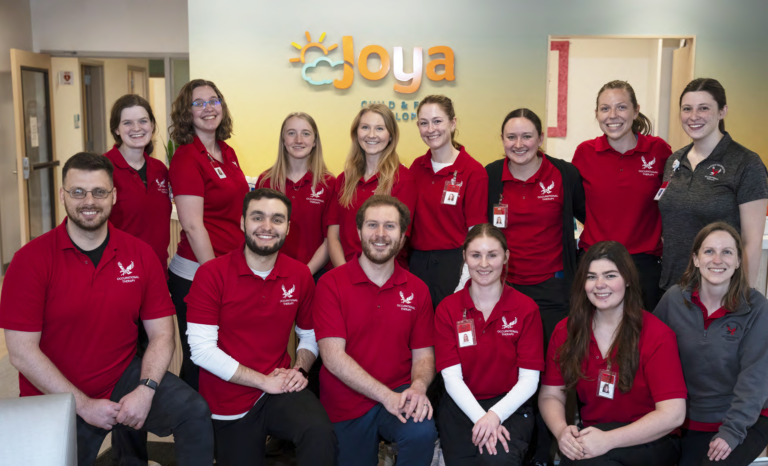
You’ll be part of a close-knit cohort of students from diverse academic and professional backgrounds. Together, you’ll learn from one another, gain new perspectives, and develop your professional identity in a supportive, collaborative environment.

In just 2.5 years at our Spokane campus, you’ll graduate ready to provide ethical, person-centered care and to lead with compassion, think critically, and make a difference in the lives of individuals and communities.

Request Info Apply


Why Choose EWU's MOT Program?

Get a hands-on education, real-world experience, and personalized support from faculty so you can launch your career with confidence.


Applied Learning

Build clinical skills through labs, simulations, and fieldwork experiences that prepare you for occupational therapy settings.

Close-Knit Community

Learn in small cohorts where collaboration, connection, and peer support are part of your everyday experience.

Faculty Mentorship

Work closely with experienced faculty who are invested in your growth as a student and future professional.

Regional Impact

Gain practical experience serving communities across the Inland Northwest, developing your skills while making a local impact.

Affordable OT Program

Benefit from competitive tuition rates and financial aid options designed to help you graduate with little to no debt.


Setting Students Up For Success

"This program has really helped me grow and set me up to be successful in the field of occupational therapy with all the hands-on learning experiences and opportunities to build relationships in the community." — Angie Ramirez '27

Program Structure

The Occupational Therapy degree program is offered full-time and in-person at the EWU Spokane campus, commencing each fall. Our program is intentionally small and selective, admitting only 32 students each year from a competitive pool of applicants.

Upon completing your coursework, you will gain practical experience through 24 weeks of full-time fieldwork with licensed occupational therapists in professional settings. This hands-on training is crucial for developing your skills and preparing for licensure.

EWO OT students work with residents of a retirement community

Application Process 2026-27 Cycle

Eastern Washington University Occupational Therapy program accepts applications annually for an August class start date.

  • Applications for 2026-27 cycle open mid-July 2026
  • Applications for 2026-27 cycle close November 15, 2026  (2 p.m. U.S. Pacific time, 5 p.m. U.S. Eastern time)
  • All applications are reviewed as they come in—no priority is given to applications received earlier in the cycle. During the open period, applications are available on the Occupational Therapist Centralized Application Service (OTCAS).

Apply

2026-27 Application Cycle General Requirements (opens mid-July 2026 and closes November 15, 2026)

The following are required for acceptance to the Occupational Therapy program:

  • Apply to the appropriate entry path and pay the associated fees for the Occupational Therapy program online application in OTCAS by the deadline listed above.  We have allowed enough time in the review process for applications to be verified by OTCAS as this process may take 48 hours or longer.
  • Program applicants must complete all program entry requirements as outlined in the applicant’s offer email from the Department of Occupational Therapy by the start of the fall semester of the application year.

The following items are required to be completed at the time of submission of the OTCAS application:

  • Meet the requirements for admission to EWU Graduate Studies.
  • Official transcripts from all higher education institutions attended received and verified by OTCAS by the application submission deadline.
  • Evidence of Undergraduate Bachelor’s degree completion.  Degree must be posted and verified by Graduate Studies before the start of the fall semester of the application year.
  • Completion of 7 of the required 9 program prerequisites with a minimum of 3.0 GPA.  All courses accepted for prerequisites must have a passing grade of a P or a 2.0 (letter grade equivalent of C) or higher.  Input prerequisites completed and in progress as directed in OTCAS.  If an applicant has not completed 7 out of 9 prerequisites at the time of application but plans to meet all requirements by the time the OT program starts in August please send an email to ot@ewu.edu requesting a review.
  • Demonstrated experiences with persons with disabilities or living with life challenges to include voluntary or work experience of 40 hours or more.
    • At least 10 of the 40 hours must be shadowing or observing an Occupational Therapist.  Telehealth hours do count toward observation/shadowing.  Applicants must upload a completed PDF of EWU’s Department of Occupational Therapy 02.EWU OT Observation Hours Log to the Documents section of the OTCAS application.
  • Responses to all EWU specific questions completed in OTCAS.
  • Submission of 3 letters of recommendation from the recommender to OTCAS as follows:
    • One from a licensed OT practitioner
    • One from: (1) a college professor OR (2) an employer of at least 6 months
    • One as a character reference from someone not related to applicant

2026-27 Application Cycle Prerequisites (opens mid-July 2026 and closes November 15, 2026)

All prerequisite coursework must be taken at a regionally accredited college or university for a letter/number grade (not through certificate programs). Courses taken with a narrative grading system must be evaluated by the granting institution and a letter grade assigned. International courses must be evaluated by World Education Services or another credential evaluation service recognized by National Association of Credential Evaluation Services.

REQUIRED:

  • General Biology with lab
    This course must include chemistry of living systems and cell functions. A college chemistry for non-majors or chemistry for the health sciences course can be substituted.
  • Human Anatomy with lab
    Either a college level Human Anatomy course or the first course of a combined anatomy and physiology series of courses fulfills the Human Anatomy with lab prerequisite.
  • Human Physiology with lab
    Either a college level Human Physiology course or the second course of a combined anatomy and physiology series of courses fulfills the Human Physiology with lab prerequisite.
  • Intermediate English Composition
    An intermediate English composition course.  A course designated by a college/university or academic department as “writing intensive” can also fulfill this requirement. Applicants should submit course descriptions along with proof that the institution considers the course a writing intensive one to ot@ewu.edu for review.  Applicants who have already earned a master’s degree in a different field are exempt from this requirement.
  • Introduction to Sociology
    Content includes concepts, principles and theories of sociology that explain social behavior in non-psychological terms to understand how human beings fit their activities together into a system of social arrangements.  Must include multiple social systems.  For additional information on the breadth of this category please email ot@ewu.edu.
  • Abnormal Psychology
    A college level abnormal psychology course.
  • General Psychology
    We will accept General Psychology Advanced Placement credit under one of two conditions: (1) the AP credit is recorded on an accredited institution transcript as equivalent to a college level General Psychology course with a passing grade, or (2) the institution granted test credit and the applicant was took higher level college Psychology courses with a passing grade.
  • Life Span (Human Development or Developmental Psychology)
    A college level human development or developmental psychology course that covers the lifespan of a person.
  • Statistics
    A college level introduction to statistics course.

Go to: OTCAS.

  1. Create an OTCAS account and follow the prompts.
  2. Submit your documents as listed under General Requirements in step 2.
  3. Enter your completed Course Prerequisites as stated in step 3.

2026-27 Application Review Criteria (opens mid-July 2026 and closes November 15, 2026)

The following application elements are initially reviewed on all OTCAS applications received by the submission deadline:

  • Prerequisites
  • Observation/Volunteer/Work Experience
  • Letters of Recommendation
  • EWU-specific essay question(s)

From the applicants who meet the minimums we pull approximately 70-75 to interview.  Interviews are typically held in January following the end of the application cycle.

After the interview, a final selection of 35 individuals plus about 25 wait-listed individuals is compiled based on a complete records review and the results of the interview’s two activities:

  • Group interview
  • Group challenge activity

Program Acceptance Statistics

  • 70+ applicants interviewed, 35 accepted each year
  • 2025-26 cycle Prerequisites GPA: average 3.70; lowest 3.17

During the progression of occupational therapy coursework, development of a high level of professionalism is a focus. Students are expected to demonstrate professional behaviors in classes, fieldwork experiences, and interactions with other students, instructors, clients, staff, faculty, and other University personnel.  Professional behaviors include: responsibility, competence, communication, integrity, cooperation/teamwork, respect and initiative. Students will be expected to use good judgment regarding appropriate dress and grooming for classes and Fieldwork I and II placements. Emotional maturity is expected in all professional matters throughout the OT Program.  Students accepted into the program are assessed as they progress using a Professional Behaviors Assessment tool located in the current OT Student Handbook they are given at Orientation during their first summer term.

Professionalism is expected by those who are trained to do a job well and is demonstrated when that professional uses skill, good judgment, and polite behavior expected from a professional.  There are also guidelines, rules and laws that govern the professional conduct expected of an Occupational Therapist.  It is critical that you review these documents and fully understand them.

Please reference the program homepage for additional program resources and information:

  • Student Outcomes
  • Licensure
  • Professional Associations
  • Cost of Program, Tuition and Fees
  • Graduate and Program Requirements, Policies and Procedures
  • Complaint Process

Anyone interested in Eastern’s OT program should attend an information session with our Director of Admissions via Zoom (August-December).

  • Register for the information session you want to attend.
  • You will receive a confirmation email containing information about joining the meeting.

Current information sessions list are noted below.

  • Check back in August for session list.

Please address any questions to ot@ewu.edu.


Application

Complete the EWU OT application through OTCAS.

  • EWU charges a program application fee payable through a link in OTCAS.
  • This is in addition to the OTCAS application fee.

Apply


Options for Visiting: There are no guided tours available on this campus.  You are welcome to come to campus while buildings are open (Monday-Friday 8am-5pm during the school year).  Please email ot@ewu.edu to arrange a campus visit with the admissions committee.

OT Program Highlights

In the MOT program, you’ll build the knowledge and hands-on skills to become a confident, entry-level occupational therapist.

Your coursework combines theory with practice, helping you develop:

  • Clinical and general practice skills used across occupational therapy settings
  • Leadership and collaboration skills to work effectively on interdisciplinary teams
  • Critical and creative thinking to solve real-world challenges
  • A strong ethical foundation grounded in person-centered, holistic care

Our graduates have diverse backgrounds, with common undergraduate degrees including psychology, biology, exercise science, and interdisciplinary studies. However, the program has also welcomed students from various other majors.

OT student works with a young child

What You'll Learn

The following information comes from the official EWU catalog, which outlines all degree requirements and serves as the guide to earning a degree. Courses are designed to provide a well-rounded and versatile degree, covering a wide range of subject areas.

Occupational Therapy, Master of Occupational Therapy (MOT)

All courses are required for the award of a Master of Occupational Therapy degree. For students entering through the Combined Bachelor's and Master of Occupational Therapy degree options, the first three semesters' credits will be assigned towards their Bachelor's degree plan and the remaining credits will be assigned towards the Master of Occupational Therapy degree plan. For questions, contact Graduate Programs. 

Required Courses
OCTH 500S
500SP
APPLIED ANATOMY AND BIOMECHANICS
and APPLIED ANATOMY AND BIOMECHANICS PAS
5
OCTH 503S
503SP
APPLIED NEUROLOGY
and APPLIED NEUROLOGY PAS
4
OCTH 504STHEORY AND FOUNDATIONS3
OCTH 506SCLINICAL PRACTICE SKILLS I3
OCTH 507S
507SP
ACTIVITY ANALYSIS
and ACTIVITY ANALYSIS PAS
3
OCTH 510S
510SP
GROUP PROCESS
and GROUP PROCESS PAS
3
OCTH 511SETHICS, PROFESSIONALISM AND CROSS-CULTURAL LEARNING4
OCTH 513SCLINICAL PRACTICE SKILLS II3
OCTH 520SPRINCIPLES OF EVIDENCE BASED PRACTICE2
OCTH 523S
523SP
ASSESSMENT AND EVALUATION OF OCCUPATIONAL PERFORMANCE
and ASSESSMENT AND EVALUATION OF OCCUPATIONAL PERFORMANCE PAS
3
OCTH 524SRESEARCH FOUNDATIONS2
OCTH 530S
530SP
OCCUPATIONAL PERFORMANCE AND MENTAL HEALTH
and OCCUPATIONAL PERFORMANCE AND MENTAL HEALTH PAS
5
OCTH 531S
531SP
OCCUPATIONAL PERFORMANCE AND ADULTS
and OCCUPATIONAL PERFORMANCE AND ADULTS PAS
5
OCTH 532S
532SP
OCCUPATIONAL PERFORMANCE AND PEDIATRICS
and OCCUPATIONAL PERFORMANCE AND PEDIATRICS PAS
5
OCTH 533S
533SP
OCCUPATIONAL PERFORMANCE AND OLDER ADULTS
and OCCUPATIONAL PERFORMANCE AND OLDER ADULTS PAS
5
OCTH 540SHEALTH AND WELLNESS3
OCTH 541SASSISTIVE TECHNOLOGIES3
OCTH 542S
542SP
LEADERSHIP AND EMERGING PRACTICE
and LEADERSHIP AND EMERGING PRACTICE PAS
4
OCTH 591SCLINICAL FIELDWORK I: ADULTS1
OCTH 592SCLINICAL FIELDWORK I: PEDIATRICS1
OCTH 593SCLINICAL FIELDWORK I: MENTAL HEALTH1
OCTH 601SPROFESSIONAL PROJECT I3
OCTH 602SPROFESSIONAL PROJECT II3
OCTH 691SCLINICAL FIELDWORK LEVEL II: ROTATION 18
OCTH 692SCLINICAL FIELDWORK LEVEL II: ROTATION 28
Total Credits90
 

Courses could be offered in different terms, checking with the academic department is paramount in keeping an individual plan current.

First Year
Fall SemesterCreditsSpring SemesterCreditsSummer SemesterCredits
OCTH 500S
500SP
5OCTH 503S
503SP
4OCTH 520S2
OCTH 504S3OCTH 507S
507SP
3OCTH 540S3
OCTH 506S3OCTH 523S
523SP
3OCTH 541S3
OCTH 511S4OCTH 531S
531SP
5 
OCTH 524S2OCTH 591S1 
 17 16 8
Second Year
Fall SemesterCreditsSpring SemesterCreditsSummer SemesterCredits
OCTH 510S
510SP
3OCTH 513S3OCTH 691S8
OCTH 532S
532SP
5OCTH 530S
530SP
5 
OCTH 542S
542SP
4OCTH 533S
533SP
5 
OCTH 592S1OCTH 593S1 
OCTH 601S3OCTH 602S3 
 16 17 8
Third Year
Fall SemesterCredits  
OCTH 692S8  
 8  
Total Credits 90

Applied Learning Opportunities

  • Applied Laboratory Work: Build hands-on clinical skills in lab settings designed to simulate real occupational therapy environments.
  • Classroom-Based Applied Learning/Simulation: Work through real-world scenarios using case studies, role-playing, and simulations. 
  • Clinical Experiences: Learn in local healthcare facilities where you can practice skills, work with clients, and prepare for certification.
  • Community-Based Learning: Partner with local organizations to support individuals and communities through occupational therapy.
  • Fieldwork: Complete Level I and Level II fieldwork experiences—including 24 weeks of full-time placement with licensed occupational therapists—where you’ll apply your skills in real-world practice settings.
  • Research: Collaborate with professors on research projects where you ask questions, solve problems, and present what you discover.
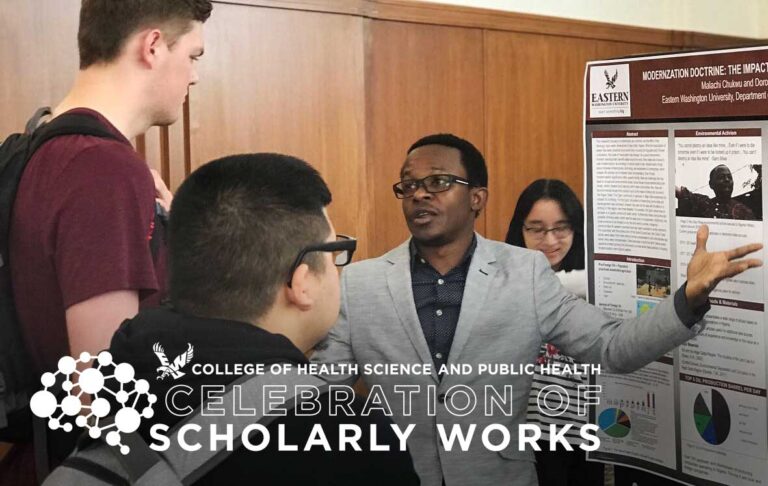
 An EWU occupational therapy student presents her research

MOT Program FAQs

All classes are held in person at the Catalyst Building in downtown Spokane. A new cohort begins each fall.

The program can be completed in just 2.5 years, including coursework and required fieldwork experiences.

Graduate students may be eligible for some EWU scholarships, including program-specific scholarships. You can complete just one scholarship application to be considered for a variety of EWU scholarship opportunities.

Eastern provides for students seeking entry into the profession as an occupational therapist:

  • Earned Bachelor Degree by the start of the fall term of the year after application – Entry into graduate studies and the OT course sequence upon admission into the program.

International students must be admitted to Graduate Studies. Information can be found on the International Graduate web page. Specific Official English Proficiency Test Scores for admission to the OT program:

TOEFL iBTPBTPTEIELTS
92580637.0

The program is selective, with around 32 students admitted each year from a pool of more than 100 applicants. This small cohort size helps create a supportive, close-knit learning environment.