BAE in Literacy, Reading & Writing Education

About

The literacy major provides prospective teachers with the tools to support reading and writing instruction, benefiting their students across disciplines by improving comprehension. Candidates will study effective teaching and assessment strategies for the development of reading, writing, presentation and speaking skills. This specific degree is for elementary majors, but we also offer one for secondary majors.

In this program, you’ll take coursework in children’s/young adult literature, content literacy, writing across the curriculum, and literacy assessments. We encourage you to become a member of the Eastern Reading Council, which supports community literacy activities.

View Requirements

Application Process

What You'll Learn

The following information comes from the official EWU catalog, which outlines all degree requirements and serves as the guide to earning a degree. Courses are designed to provide a well-rounded and versatile degree, covering a wide range of subject areas.

Literacy, Reading & Writing Education Major, Bachelor of Arts in Education (BAE)

This major satisfies the endorsement for preschool to grade 12.

The BAE in Literacy, Reading and Writing prepares teacher candidates to teach in grades P–12 in all aspects of literacy. Candidates completing a major in Literacy, Reading and Writing will demonstrate proficiency in the Reading Endorsement competencies through the state of Washington.

Education students must complete the required Education Core in their declared concentration, along with the following courses.
Required Literacy, Reading and Writing Courses
EDUC 304INTRODUCTION TO ELEMENTARY READING3
EDUC 305CHILDREN'S LITERATURE STUDY AND USE4
EDUC 310LITERACY METHODS, MANAGEMENT AND ASSESSMENT IN THE ELEMENTARY SCHOOL4
EDUC 320ASSESSING AND DIFFERENTIATING LITERACY INSTRUCTION4
EDUC 401YOUNG ADULT LITERATURE STUDY AND USE4
EDUC 403LITERACY ASSESSMENT PRACTICUM1
EDUC 411LITERACY FOR LINGUISTICALLY AND CULTURALLY DIVERSE LEARNERS4
EDUC 412CONTENT AREA LITERACY: MANAGEMENT AND ASSESSMENT FOR LITERACY MAJORS AND MINORS4
EDUC 416WRITING PROCESS ACROSS THE CURRICULUM4
EDUC 490
EDUC 494
LITERACY MAJOR CAPSTONE
and LITERACY SEMINAR AND PRACTICUM (must be taken concurrently)
8
Electives–choose one3-5
A GLOBAL VIEW THROUGH CHILDREN'S LITERATURE
INEQUALITIES AND IMPACTS ON EDUCATIONAL EQUITY
INSTRUCTIONAL MEDIA AND TECHNOLOGY
EARLY LITERACY
NATURAL RESOURCES CAPSTONE
LANGUAGE STRUCTURE AND USE
Select Concentration46-57
The elementary literacy concentration provides students with coursework to be eligible to test for K-8 elementary and P-12 literacy endorsements. The secondary route provides students with coursework to test for P-12 literacy endorsement only. NOTE: credit totals are different for elementary route or secondary route.
Elementary Education Concentration
FOUNDATIONS OF ASSESSMENT
FOUNDATIONS OF ELEMENTARY CLASSROOM MANAGEMENT
LANGUAGE AND SOCIAL STUDIES METHODS 1: INTEGRATED LANGUAGE ARTS FOR ELEMENTARY SCHOOL
LANGUAGE AND SOCIAL STUDIES METHODS 2: INTEGRATED SOCIAL STUDIES FOR ELEMENTARY SCHOOL
INTEGRATED STEM METHODS 1
INTEGRATED STEM METHODS 2
FIELD EXPERIENCE 1
FIELD EXPERIENCE 2
FIELD EXPERIENCE 3
FULL-TIME STUDENT TEACHING
Secondary Education Concentration
FOUNDATIONS OF INSTRUCTION AND ASSESSMENT
FOUNDATIONS OF CLASSROOM COMMUNITY AND CULTURE
FOUNDATIONS OF TEACHING, LEARNING, AND MOTIVATION IN SCHOOL CONTEXTS
UNDERSTANDING EDUCATION IN THE US
PEOPLES AND GOVERNANCE OF THE PACIFIC NORTHWEST
SECONDARY APPLIED INSTRUCTION AND ASSESSMENT
PRACTICES OF CLASSROOM COMMUNITY AND CULTURE IN SECONDARY CLASSROOMS
DESIGNING EQUITABLE LEARNING IN SECONDARY CLASSROOMS
PROFESSIONAL PRACTICE: COLLABORATION AND PARTNERSHIPS
FIELD EXPERIENCE 1
FIELD EXPERIENCE 2
FIELD EXPERIENCE 3
FULL-TIME STUDENT TEACHING
Total Credits89-102

The following plan of study is for a student with zero credits. Individual students may have different factors such as: credit through transfer work, Advanced Placement, Running Start, or any other type of college-level coursework that requires an individual plan.

Courses could be offered in different terms, checking the academic schedule is paramount in keeping an individual plan current. Students should connect with an advisor to ensure they are on track to graduate.

All Undergraduate students are required to meet the Undergraduate Degree Requirements.

First Year
Fall QuarterCreditsWinter QuarterCreditsSpring QuarterCredits
EDUC 2013ENGL 2015MATH 2094
ENGL 1015MATH 2085SPED 3634
Humanities & Arts BACR 115Humanities & Arts BACR 215Natural Science BACR 115
  Elective - minor or general elective2
 13 15 15
Second Year
Fall QuarterCreditsWinter QuarterCreditsSpring QuarterCredits
CMST 201 or 3405ART 3903MUSC 4503
MATH 2104PSYC 2045PHED 3903
Social Science BACR 115SOST 300 (Diversity - graduation requirement)5Social Science BACR 215
 Natural Science BACR 215Global Studies - graduation requirement15
 14 18 16
Third Year
Fall QuarterCreditsWinter QuarterCreditsSpring QuarterCredits
EDUC 3043EDUC 3033EDUC 3204
EDUC 3054EDUC 3104EDUC 4031
EDUC 4014EDUC 3384EDUC 4124
EDUC 4114EDUC 3404EDUC 4164
 EDUC 386A2 
 15 17 13
Fourth Year
Fall QuarterCreditsWinter QuarterCreditsSpring QuarterCredits
EDUC 3083EDUC 386C5EDUC 42315
EDUC 3804EDUC 490 (Senior Capstone - graduation requirement)5 
EDUC 3814EDUC 4943 
EDUC 386B2Literacy Elective23-5 
 13 16-18 15
Total Credits 180-182
1

University Graduation Requirements (UGR) and Breadth Area Course Requirements (BACR) courses may be less than 5 credits and additional credits may be required to reach the required 180 total credits needed to graduate.  Students should connect with an advisor to ensure they are on track to graduate.

2

Literacy Elective - choose one course for 3-5 credits from the approved list.

What You'll Learn

The following information comes from the official EWU catalog, which outlines all degree requirements and serves as the guide to earning a degree. Courses are designed to provide a well-rounded and versatile degree, covering a wide range of subject areas.

All prerequisites must be completed prior to admission: Contact the Undergraduate Advisor in the School of Education.

Admission Requirements

  • Complete all in-person and online admission requirements.
  • A grade of ≥C in Mathematics prerequisites.
  • A grade ≥B- in all other prerequisite courses listed below is required.
  • GPA Requirement: a minimum overall ≥2.8 GPA.
  • Provide scores for the Washington Educator Skills Test-Basic (WEST-B), SAT, and/or ACT (Reading, Writing, and Math). This is a state requirement that must be met before full admission.

In addition to the above, the following are prerequisites specific to programs and certificates.


Elementary Education Program Prerequisites

  • Education: EDUC 201 and SPED 363 or an approved equivalent
  • English: ENGL 201  or an approved equivalent
  • Mathematics: Students will be required to complete MATH 210, or  an approved equivalent, as prerequisites before starting the program.
  • Social Studies: SOST 300
  • Speech: CMST 201 or CMST 340  or an approved equivalent
  • Other: ART 390MUSC 450PHED 390PSYC 204   or an approved equivalent
  • All prerequisite courses must have been completed within the last 6 years. 

P-3 Blended: Early Childhood/Special Education Program Prerequisites


Post-Baccalaureate Certificate (Candidate holds a BA/BS from an approved institution)

Elementary

Secondary


Transition to Teaching Alternative Route: Consult with the Transition to Teaching Director in the School of Education.

Grade Requirements

Undergraduate Programs

Admission Overall GPA ≥2.8
Maintain GPA ≥2.8 in program

  • A grade of ≥C in Mathematics prerequisites.
  • A grade ≥B- in all other prerequisite courses
  • ≥B- in education core
  • Specific content areas including majors and minors may have additional grade requirements

A minimum grade ≥C is required in any content course leading to a secondary, middle level, or P-12 endorsement  

Graduate Programs

Automatic Admission GPA ≥3.0
Maintain GPA ≥3.0 in program
  • Maximum of two C grades

Applied Learning Opportunities

  • Field Work & Practicums: Develop practical, hands-on skills in structured field placements required for professional certification.
  • Undergraduate Research: Collaborate with faculty on research projects as you investigate questions and analyze findings and results.
  • Volunteerism: Give back to your community while gaining experience, building connections, and seeing how you can apply your classroom knowledge to make an impact in the world.
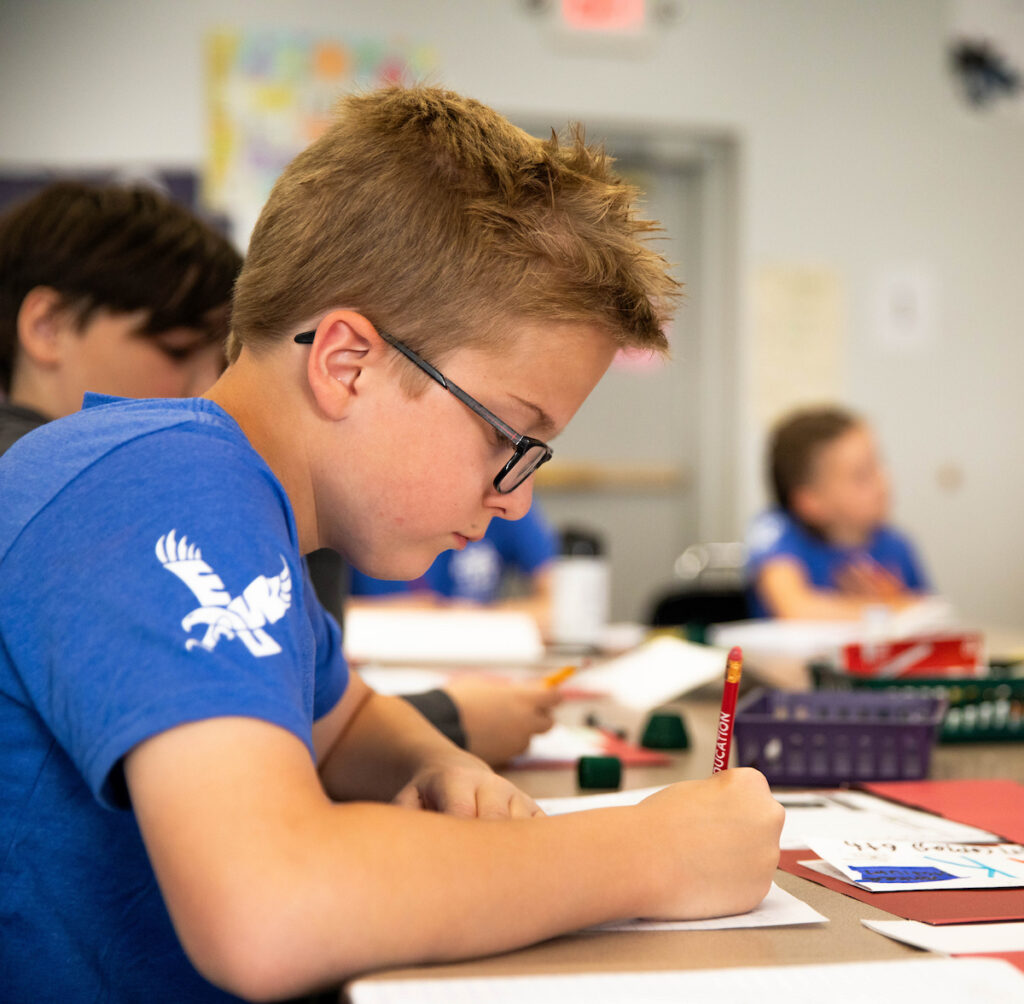
An elementary school student writes in a notebook